Roblox’s improved physics replication system is designed to make the final state of moving objects more reliable across a server and its connected clients. The June 2026 rollout introduced an eventual-consistency approach intended to prevent a dropped or delayed packet from leaving a physics-driven part permanently displayed in the wrong resting position.
For creators, the important point is that this is an engine-level replication change—not a new Luau API for moving parts. It affects how Roblox synchronizes physics state between the server and clients, and it should be tested against the specific movement, ownership, and gameplay systems in each experience.
Quick answer: What changed?
Workspace.ImprovedPhysicsReplication controls whether an experience uses Roblox’s improved physics replication path. Roblox says the updated system aims to ensure that final physics updates reach observers before a part falls asleep. That can reduce persistent visual desynchronization after collisions, explosions, and other physics-heavy events.
The Creator Hub reference describes the property as a RolloutState setting. Enabled uses the improved path, Disabled opts the place out, and Default follows Roblox’s engine-wide rollout state. The property is not scriptable, so developers should manage it through the Workspace properties in Studio rather than trying to change it from a Luau script.
Why Roblox is changing physics replication
Physics objects can move continuously, sometimes every simulation frame. Roblox’s earlier physics sender was optimized to prioritize relevant motion and continue working under bandwidth pressure. But the system had a weakness: it did not guarantee eventual consistency for the final state of a part.
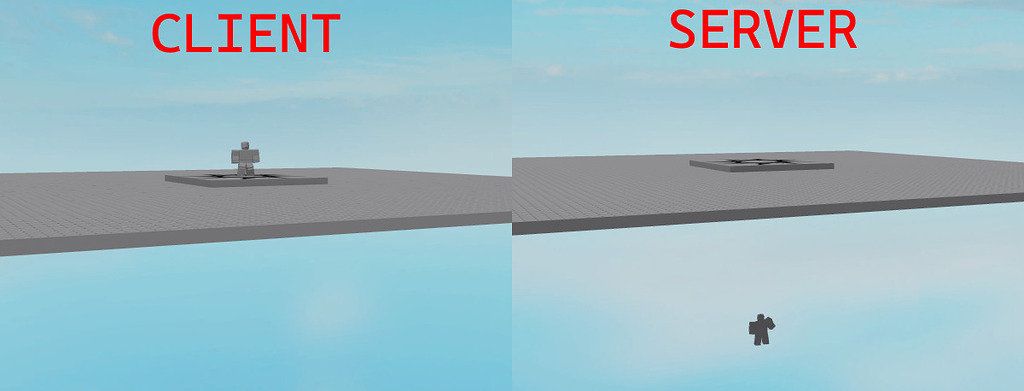
Consider an explosion that scatters dozens of unanchored parts. If a client misses the last position update for one part, that client may let the part fall asleep at an outdated position. The server and other players can see the object in its correct resting place while one observer sees it floating somewhere else. Roblox’s improved path is designed to confirm the final resting state across observers.
What “eventual consistency” means in a Roblox game
Eventual consistency means that temporary network delays do not have to become permanent disagreement. A moving assembly can still be subject to bandwidth limits and update prioritization, but the replication system makes a further effort to deliver the final state before the physics simulation considers the part settled.
This distinction matters: the update is not a promise of zero latency, zero jitter, or unlimited bandwidth. Roblox’s announcement specifically says that bandwidth constraints remain. The improvement targets the missing-final-update problem, not every possible cause of physics instability.
What developers should know about the rollout
Roblox announced early testing through Workspace.ImprovedPhysicsReplication in June 2026. The June 15 rollout note explained that physics network statistics could disappear or fall to 0 KB/s after the experience moved to the new replication pipeline. Roblox directed developers to use the newer Instance State Replication (ISR) statistics instead of interpreting those old physics counters as proof that replication had stopped.
The announcement also recorded reports of regressions in some experiences. On June 16, Roblox added a temporary Disabled option so affected developers could opt out while issues were investigated. A July 14 update said the disabled option would remain available until remaining bugs were addressed, followed by a two-week validation window. That history is why developers should not treat the original rollout announcement as the final word on compatibility.
Improved Physics Replication is not Server Authority
These features are related to Roblox’s broader replication architecture, but they are not interchangeable. ImprovedPhysicsReplication selects an improved path for synchronizing physics state. Workspace.NextGenerationReplication is a broader replication system, and Roblox’s announcement notes that Server Authority requires Next Generation Replication to be enabled.
Do not assume that enabling Improved Physics Replication automatically turns on Server Authority, changes network ownership rules, or makes all game logic authoritative on the server. Review the relevant Workspace settings and the official documentation for each feature independently.
How to test the setting safely in Roblox Studio
- Open the experience in Roblox Studio and select Workspace in the Explorer.
- Find
ImprovedPhysicsReplicationin the Properties panel. - Record the current value before changing anything.
Defaultfollows Roblox’s current engine rollout. - Test a published test place or controlled staging version before changing a live experience.
- Use repeatable scenarios: explosions with many loose parts, server-owned moving assemblies, player-owned assemblies, respawns on moving platforms, and network ownership transfers.
- Compare what the server and multiple clients see. Test with Studio network simulation and real devices where possible.
- If a regression appears, capture a minimal reproduction place, note the Studio/client version and setting values, and report it through the Roblox Developer Forum bug-report process.
Known caveats and practical testing advice
Roblox’s original announcement acknowledged that improved physics replication would not solve every mismatch. For example, anchoring is a property update, and its arrival can still become desynchronized from physics state during complex dynamic events. The announcement described a longer-term goal of bringing continuous physics data and other continuously changing properties into a more coordinated replication architecture.
Developer Forum reports also show why controlled testing matters. Some creators reported character-position mismatches, network-ownership edge cases, jitter, or other regressions after enabling the setting. Roblox staff responded to individual reports, and at least one client-owned tool-part replication report was later marked fixed after a July fix. A separate respawn mismatch discussion received further investigation and an October 2026 staff reply noting that a fix should be picked up by restarting Studio, while the reporter said the issue could still be reproduced. These reports are case-specific; they should not be generalized into a claim that every Roblox experience is affected.
For production games, test the exact mechanics that matter to your experience. A vehicle game, a physics puzzle, a fighting game with knockback, and a social hangout with mostly static props can expose very different replication edge cases. Pay particular attention to network ownership changes, server-driven movement, character respawns, constraints, and long-distance interactions.
Does improved physics replication increase bandwidth?
Roblox’s June announcement says the bandwidth limitations are not changed. The new system is intended to make sure final updates are confirmed, not to transmit every intermediate movement update without limits. The platform also said that the old physics network statistics may no longer be meaningful after the pipeline change, so use the recommended ISR statistics when diagnosing traffic.
Should you enable it for an existing game?
There is no universal yes-or-no answer for every project. If your experience relies heavily on moving assemblies, collisions, vehicles, or player interactions, build a focused test matrix and compare the behavior across clients before adopting a setting change. If you see a reproducible regression, preserve the reproduction file and use the supported opt-out value if it is available in your Studio version while you investigate.
Most importantly, do not change multiple replication settings at once. Keeping a record of the original values makes it easier to identify which setting is responsible for a behavior change.
Frequently asked questions
What does Workspace.ImprovedPhysicsReplication do?
It controls whether an experience uses Roblox’s improved physics replication path between the server and clients. The design goal is to make final physics state updates reliably reach observers.
Is ImprovedPhysicsReplication a Luau API?
No. The Creator Hub lists it as a non-scriptable Workspace property. Configure it in Studio’s Workspace Properties panel.
Does it fix every physics desync?
No. It addresses a specific eventual-consistency weakness. Roblox has documented remaining caveats involving property timing and complex dynamic events, and developers have reported individual edge cases.
Is it the same as NextGenerationReplication?
No. They are separate Workspace settings. Roblox describes Next Generation Replication as a broader system and notes its relationship to Server Authority.
Why did my physics network statistic drop to zero?
Roblox said the old physics network statistic could disappear or show 0 KB/s after switching to the new pipeline. The announcement directs creators to Instance State Replication (ISR) statistics for the new path.
What should I do if enabling it breaks my game?
Reproduce the issue in a controlled test place, record the setting values and client version, and submit a clear bug report with a minimal place file. If the Disabled option is available, it can be used as a temporary opt-out while investigating.
Official sources and further reading
- Roblox Developer Forum: Upcoming Improvements to Physics Replication
- Roblox Creator Hub: Workspace reference
- Developer Forum: Client-owned parts replication report and follow-up
- Developer Forum: Character replication mismatch report
By Shivam Das