By Shivam Das
For years, Joran van der Sloot’s name has been linked to one of Peru’s most isolated and severe prisons: Challapalca, a maximum-security facility high in the Andes. Its reputation rests on more than its remote location. The prison sits at extreme altitude, is difficult for families to reach, and has been the subject of longstanding human-rights criticism. Peruvian authorities have also described a strict security regime for high-risk prisoners, including tightly limited time in the yard.
There is an important new development. On November 7, 2026, Dutch media reported that van der Sloot had been transferred from Challapalca to the Cochamarca penitentiary after he contacted relatives and De Telegraaf by telephone. The report was based on his own communication; a public confirmation from Peru’s prison authority was not located in the reporting reviewed for this article. Challapalca remains central to understanding the conditions he experienced, but it would be inaccurate to state without qualification that he is still there today.
This is a report about what life at Challapalca has been documented to involve, what van der Sloot alleged during his imprisonment there, and what is—and is not—known about his current location. It does not claim that every historical complaint describes present-day conditions or that every allegation made by a prisoner has been independently proven.
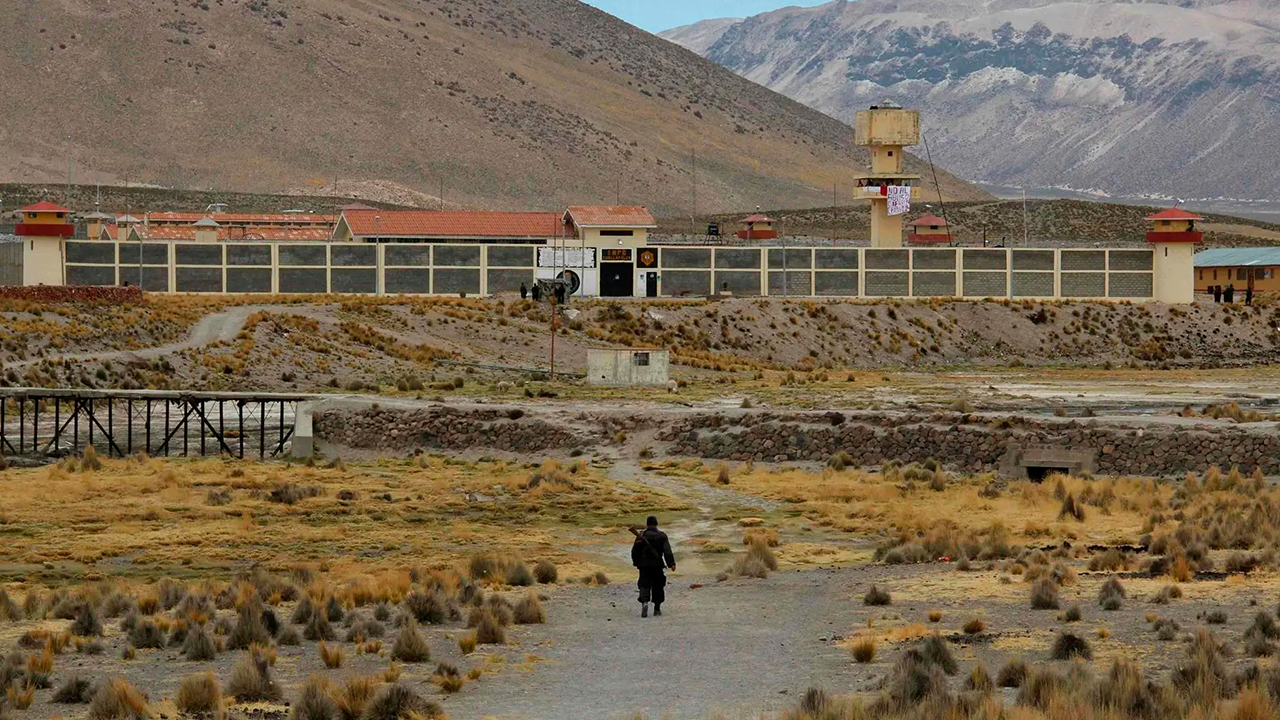
Where Challapalca is—and why its location shapes prison life
Challapalca is in Peru’s southern Tacna region, in a remote Andean area near the borders with Puno and Bolivia. The Peruvian National Penitentiary Institute (INPE) has described the facility as being more than 5,000 metres above sea level. Other reports and human-rights documents have cited an elevation of roughly 4,600 metres. The exact figure varies across sources, but the essential fact does not: this is an exceptionally high-altitude prison in a sparsely populated and difficult-to-reach area.
At this elevation, the air is thinner than at sea level, weather can be severe, and travel to the facility is difficult. A location remote for visitors is also remote for access to outside services. The Inter-American Commission on Human Rights (IACHR), after examining Challapalca in the early 2000s, described the journey from Puno as lengthy and difficult, with poor road conditions and a lack of nearby facilities for visitors.
That distance has consequences beyond inconvenience. When relatives must travel for hours across isolated terrain, visits become harder to arrange and more expensive. The same geography can complicate access to lawyers, independent observers and specialist medical care. These are structural challenges associated with the prison’s location; they are not proof that a particular visit or medical request was denied.

What the strict-security regime means in practice
Challapalca is used for prisoners whom authorities classify as high-risk or difficult to manage in other facilities. In a January 7, 2026 announcement, INPE said inmates transferred to the prison under its special extreme-security regime would have two hours of yard time and receive one family visit every two weeks, limited to one hour. The agency described the arrangements as part of a strict system of discipline and surveillance.
Those details offer a useful official description of the regime, but they need to be read precisely. INPE was describing the conditions applied to the group of prisoners moved in that operation. The announcement does not publish an individual daily timetable for van der Sloot, and it would be misleading to state that every detail necessarily applied to him at every point during his detention.
Still, the official description gives readers a sense of how restrictive life can be for prisoners placed under the extreme-security rules: limited outdoor time, controlled movement, close monitoring and infrequent family contact. For someone held far from major cities, restrictions on visits can combine with the difficulty of reaching the prison to make family contact particularly challenging.

Cold, altitude and access to medical care
Challapalca’s altitude is not merely a dramatic detail for headlines. At elevations above 4,500 metres, people can experience altitude-related health problems, especially if they arrive from much lower elevations without sufficient acclimatization. The IACHR’s report on the prison discussed risks associated with thin air and the difficulty of obtaining timely medical attention in such a remote location.
In its 2003 report, the Commission raised concerns about the prison’s ability to provide adequate health care for people with more complex medical needs. It noted the long distance to the nearest hospital and described how the prison’s location could delay access to specialized treatment. Amnesty International also criticized Challapalca in a 2004 appeal, citing its isolation, harsh temperatures and concerns about access to medical attention and basic living conditions.
Those are serious historical findings, but they are not a substitute for a current inspection report. They document concerns raised by human-rights bodies more than two decades ago. A responsible account should not present every detail from 2002 or 2004 as if it had been independently verified in 2026. The public material reviewed for this article does not provide a comprehensive, current, independent audit of every cell, medical service or daily facility condition.
There is a recent example of the prison authority publicly describing medical intervention. In December 2025, Peru’s Ministry of Justice and Human Rights said prison staff noticed an incident that compromised van der Sloot’s physical integrity, activated emergency procedures and stabilized his condition. The ministry said he remained under medical evaluation and monitoring. The statement confirmed an emergency response; it did not publicly establish every detail about what caused the incident.

What van der Sloot said about his own conditions
In August 2026, van der Sloot sought a transfer from Challapalca through a handwritten legal petition. Peruvian broadcasters América Noticias and Canal N reported that the document, dated August 5, alleged death threats from other prisoners, threats against his family and prolonged isolation in the prison’s medical area, known locally as the tópico. He said the situation was damaging his mental health and argued that his safety was at risk.
The Associated Press separately reported that his lawyer, Máximo Altez, said van der Sloot had asked a court to move him to another maximum-security prison. The lawyer described the facility’s elevation and quoted concerns contained in the prisoner’s account. These reports establish that a transfer request and allegations were made; they do not establish that a court found the allegations true.
A prisoner’s claim of threats, isolation or mistreatment deserves accurate reporting and appropriate scrutiny. But the claim itself is not an independent finding. The sources reviewed for this article do not include a published judicial ruling that accepts every allegation in van der Sloot’s petition, nor a public INPE investigation report confirming the full account as he described it.
How crowded was Challapalca in 2026?
A November 10, 2026 fact-check by PerúCheck, citing the latest publicly available INPE statistical data and a direct response from the prison authority, reported that Challapalca held 248 male inmates as of November 6. The same report said the facility’s stated capacity was 214, meaning the population exceeded that figure by 34 people.
That number is not a count of the number of people in van der Sloot’s particular unit or cell block. It is a facility-wide figure. It does, however, show why the prison’s capacity and population have become part of the debate around recent transfers and the government’s high-security policy.
Earlier in 2026, INPE reported that the prison held 228 inmates in January and 225 during a March inspection operation. The later November figure indicates that the population had increased by the time of the latest report. As with any prison statistic, the date matters: a count from August or January should not be presented as the current figure in November.

Security operations and the government’s approach
Challapalca’s role has become more prominent as Peru has moved high-risk prisoners from other facilities. In January 2026, INPE announced the transfer of 100 inmates from five prisons as part of a wider operation targeting extortion and organized crime. A separate January statement described the extreme-security regime and the arrival of additional prisoners.
In March, INPE said a joint operation at Challapalca involved 43 special-operations officers, 36 prison agents and 78 police officers. The agency reported inspections of cells, corridors and common areas, and said two mobile phones were found. It also described a monitoring centre with 138 surveillance cameras, including facial-recognition and movement-detection capabilities.
These announcements show the official emphasis on control, surveillance and preventing illicit activity inside the prison. They do not establish that every part of the prison operates without problems. In 2025, Peru’s Comptroller General identified security-system risks, including cameras that switched off and alarms that activated without an apparent reason, according to reporting by RPP. A balanced assessment must acknowledge both the authority’s stated security measures and documented concerns about their operation.
On November 3, 2026, Peru extended a state of emergency covering Challapalca and four other high-risk prisons for a further 60 days beginning November 5. The measure placed the facilities’ outer perimeters under additional security arrangements, with police maintaining internal order with support from the armed forces. That is a wider national security measure, not a finding about van der Sloot personally.
Is Joran van der Sloot still at Challapalca today?
As of November 10, 2026, the newest reports reviewed say no: Dutch media reported on November 7 that van der Sloot had been transferred to the Cochamarca penitentiary in Peru. The reports said he telephoned relatives and De Telegraaf while in transit and told them he was being moved. They did not include a public confirmation from INPE explaining the order, the reason for the move or the exact date on which the transfer was formally completed.
Readers should distinguish between three things: his long period of detention at Challapalca; the August 2026 transfer request in which he alleged threats and isolation; and the November 7 media reports that he had moved to Cochamarca. The reporting available at publication time does not establish that the move was granted as a result of his habeas corpus petition. Nor does it establish that every allegation in that petition was accepted by a court.
The transfer report does not erase the relevance of Challapalca. It remains the prison where he spent a significant period, where his 2026 transfer request arose, and whose conditions are central to the public debate around his detention. But a story published today must not describe him as definitely still living there when the latest reports say he has left.
Why the legal distinction in the Natalee Holloway case still matters
Van der Sloot is serving a 28-year sentence in Peru for the 2010 murder of Stephany Flores Ramírez. In the United States, he received a separate 20-year federal sentence after pleading guilty in 2023 to extortion and wire fraud involving Beth Holloway, Natalee’s mother. The U.S. sentence was not a murder conviction for Natalee’s death.
During the U.S. proceedings, van der Sloot admitted that he killed Natalee in Aruba in 2005. That admission brought renewed attention to a case that had remained unresolved for years, but the federal offenses of conviction were extortion and wire fraud. Natalee’s remains have not been recovered. Describing him as the man who confessed to killing Natalee is accurate; saying that the 2023 U.S. case convicted him of her murder is not.
His prison location and the legal status of Natalee’s case are separate questions. A move from Challapalca to Cochamarca does not change the convictions for which he is serving time, and it does not decide whether prosecutors in another jurisdiction will take further action over Natalee’s death.
What can responsibly be said about life at Challapalca?
The strongest evidence supports a measured picture. Challapalca is a remote, high-altitude maximum-security prison. INPE has described a highly restrictive regime for prisoners transferred under extreme-security rules, including limited yard time and infrequent family visits. Human-rights bodies raised serious concerns about medical access, isolation and harsh conditions in earlier inspections. Recent official announcements show continued security operations and a growing prison population, while reporting in August 2026 documented van der Sloot’s allegations about threats and isolation.
What the public record does not provide is a verified, minute-by-minute account of van der Sloot’s daily routine, the precise conditions of his individual cell, or a current independent inspection establishing every condition in the facility. It also does not justify treating his allegations as proven findings. The responsible answer is to explain what authorities, courts, human-rights investigators and credible reporting have actually documented.
For Natalee Holloway’s family and for viewers revisiting the case through Taken: Natalee Holloway, the prison story is part of the continuing aftermath. It shows where the man who admitted killing her spent years in custody, the restrictions and scrutiny surrounding that facility, and the uncertainty that remains after his reported transfer. It does not provide the one thing the family has never received: Natalee’s remains.
Frequently asked questions
Where is Challapalca prison?
Challapalca is a maximum-security prison in Peru’s southern Tacna region, in a remote part of the Andes near the border area with Puno and Bolivia. INPE has described it as being more than 5,000 metres above sea level; other sources cite approximately 4,600 metres.
Is Joran van der Sloot still in Challapalca prison?
Dutch media reported on November 7, 2026, that he had been transferred to the Cochamarca penitentiary. The reports attributed the information to a telephone call from van der Sloot. A public INPE confirmation of the individual transfer was not located in the sources reviewed for this article.
What are the conditions like at Challapalca?
It is a remote, high-altitude maximum-security facility. INPE has described a strict regime for high-risk prisoners that can include two hours of yard time and one family visit every two weeks for one hour. Human-rights bodies have historically raised concerns about medical access, isolation and the effects of the prison’s location.
How high is Challapalca prison?
INPE has described the facility as more than 5,000 metres above sea level. Other reports and human-rights documents cite roughly 4,600 metres. The published figures differ, but all identify it as an exceptionally high-altitude prison.
Did van der Sloot complain about conditions at Challapalca?
Yes. In an August 2026 petition, he alleged death threats, threats against his family and prolonged isolation in the prison’s medical area. These were claims in a legal filing, not findings that should be described as proven without a court or independent investigation confirming them.
How many prisoners were at Challapalca in November 2026?
PerúCheck reported on November 10, citing INPE data and a direct response from the prison authority, that the facility held 248 inmates as of November 6. The reported capacity was 214.
Was van der Sloot convicted of Natalee Holloway’s murder?
He admitted killing Natalee during the 2023 U.S. proceedings, but the federal conviction was for extortion and wire fraud involving her mother, Beth Holloway. His 28-year Peruvian sentence is for the murder of Stephany Flores Ramírez.
Why was Challapalca criticized by human-rights groups?
The IACHR and Amnesty International raised concerns in the early 2000s about the prison’s isolation, extreme altitude, difficult access to medical care and the effects of harsh conditions on prisoners and visitors. Those are historical findings and should not automatically be treated as a current inspection of every facility condition.
Sources and further reading
- INPE, January 7, 2026: extreme-security regime, yard time and family visits
- INPE, January 5, 2026: transfer of 100 high-risk prisoners to Challapalca
- INPE, March 31, 2026: security operation and surveillance systems at Challapalca
- PerúCheck, November 10, 2026: Challapalca population and capacity figures
- América Noticias: van der Sloot’s August 2026 transfer petition and allegations
- The Associated Press, August 2026: lawyer’s account of the transfer request
- Amnesty International, December 2004: appeal concerning Challapalca prison conditions
- Inter-American Commission on Human Rights: report on Challapalca prison conditions
- ANDINA, December 15, 2025: Peru’s Justice Ministry statement on van der Sloot’s medical emergency
- Dutch media report, November 7, 2026: reported transfer to Cochamarca
- El Peruano, November 3, 2026: extension of the state of emergency at high-risk prisons
- U.S. Department of Justice, October 18, 2023: federal guilty plea and sentence
Editorial note: This article distinguishes official prison-authority statements, historical human-rights findings, media reports and allegations made by the prisoner. It does not present an allegation as a judicial finding or an unconfirmed transfer report as an official INPE announcement. Photographs are attributed to their publishers; image display does not establish republication permission.