

Season 2 spoilers ahead. A well-executed action scene can make a chase feel fast. A well-executed one-shot has a harder job: it has to make the audience understand where everyone is, what is changing, and why the moment matters without relying on the usual safety net of rapid cuts. That is the appeal of the much-discussed Black Doves sequence involving Helen Webb and Laila Joshi. The cast have singled it out not just as a technical achievement, but as a scene that has to carry an emotional progression while the action keeps moving.
Ella Lily Hyland, who plays Williams, called attention to the moment in Netflix’s cast interview. Referring to Ambika Mod and Keira Knightley moving through the jeweler, she said it was “all one shot” and stressed how much work is involved when an emotional trajectory has to sit on top of that technical challenge. In a separate interview, Mod described her favorite stunt as the continuous-shot sequence at a Somerset House art exhibition, where she and Knightley move through the gallery while Laila fights off pursuers.
Those two accounts give us a valuable behind-the-scenes perspective, but they are not a published camera breakdown. The interviews do not provide a shot list that maps every location detail between Hyland’s jeweler reference and Mod’s Somerset House description. What they do establish is the ambition of the Helen-and-Laila action: a continuous-feeling passage in which choreography, performance, camera movement, and character dynamics have to work together.
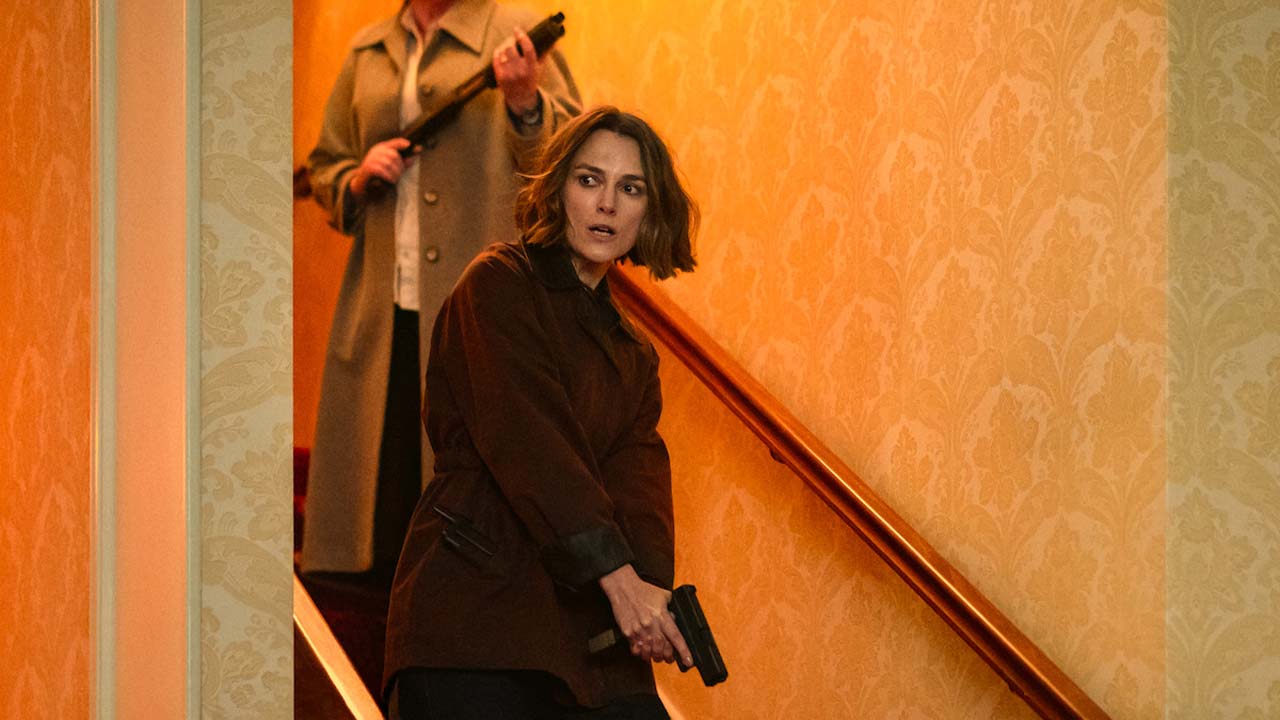
What the cast actually said about the one-shot
In Netflix Tudum’s interview with Hyland and Gabrielle Creevy, the conversation turns to how demanding the show’s action can be even for performers whose characters are not always the ones doing the most physical work. Creevy talks about the coordination required to act under gunfire while respecting the work of stunt performers and the camera crew. Hyland then points to the moment with Mod and Knightley moving through the jeweler, describing it as one shot and noting the extra difficulty of giving the sequence an emotional line.
That last point is the heart of the title. A one-shot action scene is not impressive simply because the camera keeps rolling. The shot has to communicate a change. The audience should be able to follow the physical geography, but it should also feel that the characters have moved somewhere emotionally by the time the camera stops.
Mod’s account adds a more specific description of the sequence she enjoyed performing. Speaking to Radio Times, she identified the Somerset House art-exhibition sequence as her favorite stunt. She described moving through the gallery with Knightley, striking one pursuer with a tray and throwing a champagne bottle at another. Her description makes clear that the action is built around the environment rather than simply staged in front of it.
Why the Somerset House chase feels different
Netflix’s official Season 2 locations guide confirms that Helen and Laila are pursued into Somerset House in Episode 2. The production used the real gallery, alleyway, and riverside corridors of the historic London site. That matters because the setting is not just a decorative backdrop. It gives the sequence changing spaces, thresholds, sightlines, and objects that can become part of the action.
An art exhibition is also an unusual place for a spy-thriller fight. The contrast between a carefully arranged public cultural space and sudden violence gives the sequence an extra layer of visual tension. Visitors, artworks, display furniture, and gallery architecture belong to a world of order and contemplation. Helen and Laila bring urgency and disorder into it. The scene gets energy from that collision.
It is worth separating what is confirmed from what is interpretation. Netflix identifies the real Somerset House spaces used in the chase; Mod describes the gallery movement and the improvised use of objects in the fight. The exact camera rig, lens, operator choreography, hidden transitions, and blocking diagrams have not been publicly detailed in the interviews cited here. Any claim about those specifics would go beyond the available reporting.
What makes a oner so demanding?
In film and television production, a “oner” is a sequence designed to play as one continuous shot. Sometimes a take is genuinely uninterrupted; sometimes a production can use concealed transitions to preserve the impression of continuity. In this case, the performers themselves describe the sequence as one shot or one continuous shot. Without a technical breakdown from the crew, it is better not to guess at the exact method used.
Even without knowing the equipment, the performance challenge is easy to understand. In a conventional action scene, editors can select the clearest moments from several angles. A cut can hide a reset, shorten a movement, clarify a hit, or move the audience to a new position. A continuous take removes many of those options. Timing becomes visible. A missed cue can affect what follows. The actors, stunt team, camera crew, and everyone moving through the frame must stay coordinated.
The scene also has to remain readable. If the camera moves too quickly, the viewer may lose track of the geography. If it lingers too long, the momentum can flatten. The performers need to hit marks while making the movement feel spontaneous, and the camera has to arrive at the next beat without making the whole thing look like a rehearsal.
That is why Hyland’s reference to the emotional trajectory matters. The challenge is not only to get from one end of a location to another. The sequence has to preserve the characters’ changing reactions while the physical business continues. The action cannot feel like a technical demonstration that temporarily pauses the story.
Keira Knightley, Ambika Mod, and the pressure of doing it in a oner
Knightley has also discussed the Somerset House chase in an interview with the show’s creator, Joe Barton. She recalled that director Julian Farino proposed shooting the sequence as a oner despite the limited rehearsal time available to her and Mod. The two actors questioned how that could work when they had not yet learned the fight in full. Knightley said they did manage to complete it, and that they had five takes.
That detail is revealing without needing to turn it into a legend. Five takes does not mean the scene was effortless, nor does it tell us how many rehearsals, resets, or technical preparations happened outside those attempts. It does show that the result was not simply a lucky first pass. The director’s ambition had to be translated into a workable performance under real production conditions.
Mod has spoken about the physical preparation involved in joining the series. She told Radio Times that she was not naturally coordinated and undertook stunt training for the role, adding that the cast performed most of the stunts themselves. That is not a claim that every movement in the one-shot was performed without doubles; it is a useful reminder that the action was supported by preparation and a wider stunt team.
For Knightley, the scene also belongs to a larger shift in Helen’s role. Season 2 places her under greater pressure as Wallace moves toward the prime minister’s office and the Black Doves face internal danger. Helen is not simply being protected or escorted through the story. She is an operative making decisions under pressure, and the action scenes let the audience see that competence directly.
The emotional weight is in the partnership
The most interesting thing about the sequence is that it puts Helen and Laila in motion together. Their partnership begins with friction. Helen is controlled, experienced, and used to navigating complicated relationships through a carefully managed public identity. Laila is blunt, quick, and much less interested in making the interaction comfortable. The show does not need to stop for a long conversation to establish that contrast; their physical teamwork can make it visible.
In a continuous sequence, the audience spends time with both characters in the same moving space. One has to respond to the other. A change of direction, a split-second decision, or an improvised use of an object can reveal whether they are anticipating each other or merely surviving the same danger. That is where the emotional line can live: not in a speech, but in the gradual evidence that two people with different instincts can operate together.
This is an interpretation of what the scene achieves, not a claim that the actors or director have published a hidden meaning for every movement. The interviews establish the technical ambition and the need for an emotional trajectory. The episode supplies the story context: Helen and Laila are being pursued and have to get through the danger together. The combination is what gives the sequence its weight.
It also helps explain why the action is memorable beyond the stunt itself. A fight can be spectacular and still leave the relationship unchanged. Here, the sustained movement gives the viewer time to register how the pair react under pressure. The sequence becomes part of the process by which their uneasy working relationship starts to look like a functioning partnership.
Why the props matter: a tray, a bottle, and the gallery around them
Mod’s description of the tray and champagne bottle is a useful reminder that the best action choreography often makes the location do more than provide a background. Objects that belong naturally in a gallery can become part of the characters’ immediate problem-solving. That creates a more specific kind of action than a generic exchange of punches in an empty corridor.
There is a tonal advantage, too. Black Doves regularly lets violence and dry comedy sit close together. Laila’s response to danger is often practical and irreverent; Helen’s polished exterior can coexist with startling decisiveness. A gallery chase built around everyday objects lets the show combine those qualities without turning the scene into a gag. The danger remains real inside the story, but the way the characters improvise can still be darkly funny.
The props also help the audience understand the physical logic of the scene. A tray is not simply a random weapon; it is an object that plausibly exists in a public venue. A champagne bottle has weight, shape, and a recognisable function before it becomes part of the fight. Those details make the choreography feel connected to the world rather than imported from an anonymous action set.
One continuous shot can make the audience feel the cost of every beat
Editing usually gives action scenes a rhythm by choosing when the audience sees a movement begin and when it sees the result. A one-shot approach asks the viewer to stay with the full progression. That can increase tension because there is less visual relief. It can also make the performers’ work feel more immediate: the audience watches the movement unfold rather than receiving it as a series of selected fragments.
But continuity alone does not create emotion. The shot needs a reason to exist. If the camera follows characters simply to prove that the production can do it, the technique can become a distraction. The sequence earns its place when the continuous movement supports the story: Helen and Laila are not just crossing a gallery; they are learning how to function together while the situation keeps changing.
That is the difference between a technical flex and a meaningful scene. The first makes viewers admire the execution. The second makes them remember what the execution revealed about the characters.
What is confirmed—and what remains behind the scenes
- Confirmed: Ella Lily Hyland singled out the moment with Mod and Knightley moving through the jeweler as a one-shot sequence.
- Confirmed: Ambika Mod described her favorite stunt as a continuous-shot sequence through a Somerset House art exhibition.
- Confirmed: Netflix identifies the Somerset House gallery, alleyway, and riverside corridors as locations used for the Episode 2 chase.
- Confirmed: Knightley said director Julian Farino wanted to shoot the chase as a oner and that the actors completed it after five takes.
- Not publicly established: The exact camera equipment, operator route, lens, hidden transitions, full rehearsal schedule, and a complete technical shot breakdown.
That final distinction matters. A behind-the-scenes article should not invent a camera rig or claim to know how every transition was hidden simply because a sequence looks seamless. The cast’s own descriptions are already compelling: the scene demanded coordination, physical preparation, and an emotional line that could survive without the usual editing breaks.
The sequence works because the technique serves the story
The one-shot jeweler moment is a useful example of what Black Doves does well when its action and character writing meet. The technical challenge is visible, but it is not the only point. The continuous movement gives Helen and Laila room to reveal how they respond to one another under pressure. The gallery setting adds visual contrast, while the use of ordinary objects keeps the choreography grounded in the environment.
Hyland’s comment about the emotional trajectory gets to the core of it. The difficult part is not simply keeping the camera moving. It is making sure the scene still means something while the camera moves. Mod’s account of the Somerset House stunt and Knightley’s recollection of Farino’s oner plan give us a rare glimpse of how ambitious the sequence was from the performers’ side.
That is why the moment deserves attention beyond a quick “look at this cool shot” reaction. It is a technical achievement with a dramatic purpose: the action keeps the audience inside the danger, and the uninterrupted movement lets the relationship develop in real time. When a one-shot sequence does both jobs, the technique stops being a trick and becomes part of the storytelling.
Further reading
- Laila’s Enigma Status – Why We Still Don’t Fully Know Her Backstory
- How the Younger Assassins Carry the Comic Energy This Season
- The Show’s Habit of Making Violence Feel Casually Funny
Reporting note: This article distinguishes cast-confirmed production details from analysis of the scene’s dramatic effect. No unverified camera specifications or production claims have been added.


