

Quick answer: Laila’s “I’m the muscle, baby” introduction in Black Doves Season 2 is more than a funny character tagline. In one brisk exchange, Ambika Mod’s new operative establishes Laila as physically capable, irreverent, impatient with hierarchy and entirely comfortable letting her actions do the talking. The line also sets up the friction that makes her partnership with Helen Webb so entertaining.
Spoiler note: This article discusses Laila’s introduction and selected Season 2 character moments.
The introduction works because Laila answers with action
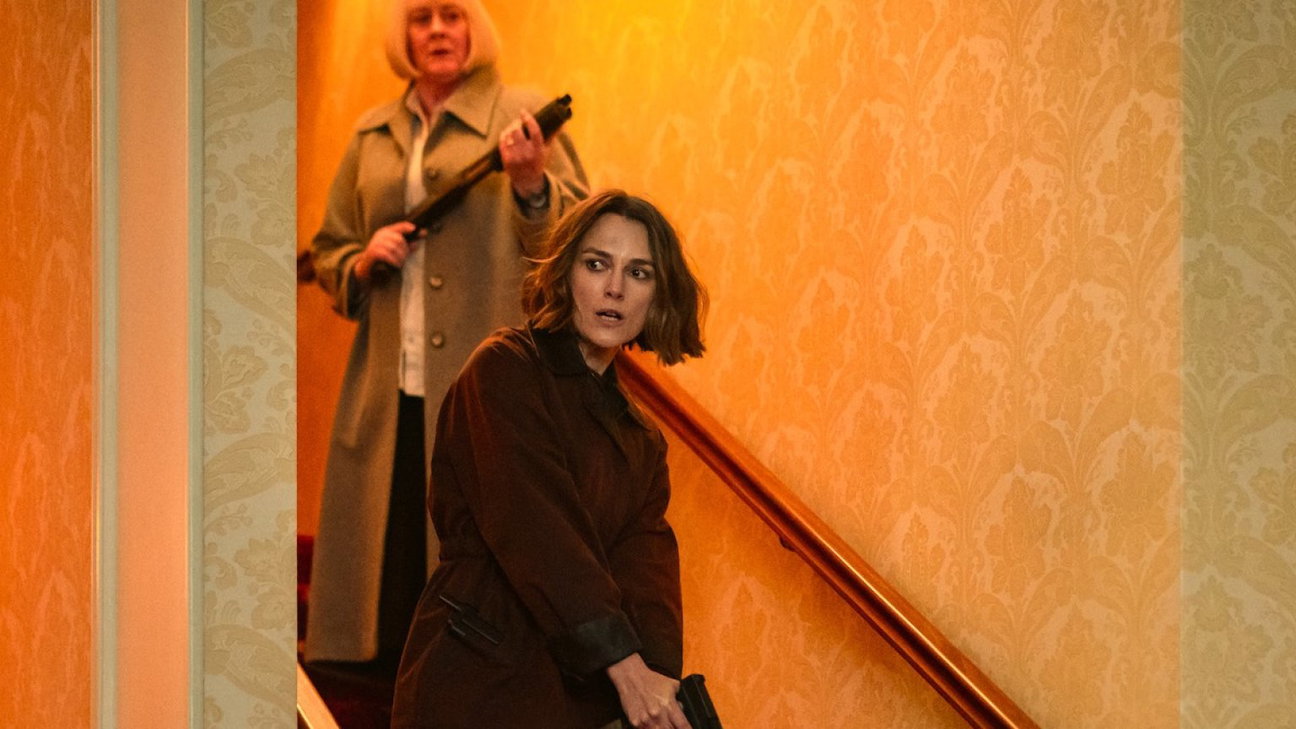
The line lands during Laila’s first encounter with Helen, when Helen asks what her role is. Laila replies, “I’m the muscle, baby.” The elevator doors open, and the answer is immediately demonstrated rather than explained: Laila takes down the armed opposition with startling speed. The joke and the action arrive almost together, giving the audience a clear picture of her personality before the series has to stop for a conventional character briefing.
That economy is the secret of the moment. A less confident show might introduce a new operative through a résumé of past assignments, a solemn warning from a handler or a long explanation of her specialist skills. Black Doves lets Laila deliver a cheeky sentence and then prove the point. It is a compact piece of visual storytelling: the dialogue gives her a voice, while the action establishes that the confidence is not empty bravado.
The word “baby” matters, too. It softens the bluntness without making Laila deferential. She is not trying to sound like a military professional or impress Helen with formal authority. She is speaking in her own register, treating a lethal job as if she is casually clarifying who is carrying which bag. That mismatch between relaxed delivery and serious violence is one of the season’s defining comic rhythms.
Ambika Mod gives the line its comic timing
Laila could easily have become a familiar action-thriller type: the younger, tougher recruit who exists mainly to provide backup. Mod makes her more specific. Her delivery is dry, fast and slightly provocative. She often seems amused by the formality around her, as if the organization’s rules are an inconvenience she has agreed to tolerate rather than a code she feels obliged to worship.
In an interview with Stylist, Mod described Laila as honest and brash, adding that the character’s confidence comes from knowing nobody can mess with her. Mod also said she wanted to do stunts, something she had not done before, and that the role felt like a chance to play someone very different from the characters audiences had previously associated with her. Those comments help explain why the physicality feels integral rather than decorative: Laila’s body language, movement and willingness to act are part of the performance, not simply action inserted around it.
Mod’s comedy background is useful here. Laila’s jokes do not arrive as polished punchlines with a pause asking the audience to laugh. They often sound like spontaneous observations from someone who is not especially interested in making a room comfortable. That gives the character a distinctive rhythm alongside Helen’s more controlled, socially calibrated manner.
Why Helen is the perfect person for Laila to challenge
Helen is experienced, controlled and accustomed to operating inside the Black Doves’ complicated hierarchy. She has spent years balancing espionage with the public demands of marriage and political life. In Season 2, Wallace’s rise to prime minister makes that balancing act even more precarious. Laila arrives with a very different attitude: she is direct, less impressed by status and happy to puncture Helen’s self-possession.
Their clash is not simply an age-gap gag. Mod told Radio Times that she saw a generational divide between the characters and described Laila as someone who roasts Helen. She also suggested that the two might approach the world from different ideological positions: Keira Knightley described Helen as “pure capitalist,” while Mod imagined something more socialist about Laila, though she acknowledged that Laila’s expensive tastes complicate that reading.
That contradiction is worth keeping. Laila’s trainers, clothes, drum kit and comfortable central-London flat do not neatly fit a simple political label. Mod herself joked that the character’s activism might be something to explore in a future season. For now, the show gives viewers a suggestive tension rather than a settled explanation. Laila can mock Helen’s access to power while also enjoying the material comforts that power and money can buy.
Helen, meanwhile, is not simply an older professional being schooled by a younger recruit. She has experience, judgment and a network of relationships Laila does not share. Their scenes work because neither woman has to be wholly right. Helen understands the institutional danger; Laila sees when institutional manners become a distraction. The friction gives both characters room to reveal their blind spots.
“The muscle” is not the whole of Laila
The phrase is memorable because it sounds like a job description, but reducing Laila to physical force would miss what makes her useful. She is quick-witted, unpredictable and comfortable improvising. Netflix’s official character guide describes Laila Joshi as quick-witted, chaotic and effective under pressure, a rogue operative whose sharp tongue can throw a mission off balance or save it. That is a more complete description than the slogan alone.
Her skill set is also not presented as a tidy list of action-hero abilities. Laila is not the person who calmly explains the plan and then executes every step perfectly. She can be irreverent, impulsive and difficult to read. Her unpredictability creates problems for people who prefer a controlled operation, but it can also be an advantage when the plan has already collapsed.
That is why her presence changes the ensemble. Helen and Sam have a long history and a shorthand that comes from years of trust, disappointment and shared danger. Laila does not have that emotional history with them. She brings a different energy into the group, one that can unsettle established relationships and make familiar characters explain themselves again.

The look is part of the character’s attitude
Laila’s styling reinforces the same refusal to behave like a conventional spy. Mod has discussed the character’s mesh layers, ringer tees, slicked-back hair and strong makeup. In the Stylist interview, she singled out the mesh tops and the amount of work involved in creating Laila’s tightly styled hair. She also said she wanted to bring parts of that wardrobe into her own style.
The clothes do not make Laila invisible, and that is precisely the point. She is not built around the classic image of a discreet operative in a dark suit. Her appearance is expressive, slightly confrontational and memorable. It helps distinguish her from Helen, whose public role requires a more polished, controlled presentation, and from the other assassins, whose own looks carry their own eccentricities.
There is a useful contrast between Laila’s appearance and her professional function. The wardrobe can look playful or deliberately casual, but the character is not harmless. The show repeatedly uses that gap between surface and capability to create surprise. Laila looks like someone who might make a cutting remark at a party; she is also someone you do not want coming through a door when you are holding a weapon.
What Mod’s interviews reveal — and what remains a mystery
Mod has been careful not to turn Laila into a fully explained psychological case. Speaking to Radio Times, she said the character is best not overthought: loose, fun and playful. She also expressed interest in discovering more about Laila’s past, asking why she is so nonchalant about her work and where she came from. In the same interview, Mod called Laila a bit of an enigma who remains that way through the season.
That restraint is smart. The line “I’m the muscle, baby” tells us how Laila wants to be seen in that moment, not everything that has made her that way. We know she has been suspended from active duty and is brought back into the story to work with Helen. We see that she can handle herself and that she is not easily intimidated. But the show leaves space around her history, loyalties and personal motivations.
My take is that the unanswered questions make the catchphrase stronger, not weaker. If the series explained every detail immediately, Laila might become a familiar bundle of backstory and trauma. Instead, she arrives as a vivid personality first. The audience gets to enjoy her before the story decides how much of her private life it wants to reveal.
Could Laila become a bigger part of the Black Doves?
Season 2 gives Laila a place in the wider team, but her independent streak raises an obvious question: can someone who prefers to work alone become a dependable member of a damaged organization? The finale’s events leave the Black Doves needing to rebuild, and Netflix’s ending explainer notes that Laila joins Eleanor and Williams in the operation to rescue Reed. Mod described Laila as a lone wolf who believes she does not need anyone, while suggesting that working with the others could begin to lower those barriers.
That is the most interesting possible direction for her. Laila does not need to become less funny or less capable to develop. The stronger arc would be to test whether she can choose to rely on people without feeling that she has surrendered her independence. Her partnership with Helen is a natural place to explore that question: both women are competent, guarded and used to making decisions alone, but they have very different ideas about what loyalty and authority should look like.
For now, the line remains a perfect introduction because it promises exactly what the character delivers: force, confidence and a joke at the moment you least expect one. But the future of Laila may depend on what happens after the joke — when the job is over and she has to decide whether the people beside her are more than temporary colleagues.
Frequently asked questions
Who says “I’m the muscle, baby” in Black Doves?
Laila Joshi, played by Ambika Mod, says the line when Helen asks what her role is during their first encounter in Season 2.
Who plays Laila in Black Doves Season 2?
Ambika Mod plays Laila Joshi, a sharp-tongued and unpredictable operative who is brought in to help Helen on a mission.
Is Laila a Black Doves agent or an assassin?
She is a Black Doves operative with a history of working as an assassin. Netflix describes her as a rogue operative who is quick-witted, chaotic and effective under pressure.
Why do Helen and Laila clash?
Their personalities and outlooks differ. Laila is blunt and irreverent, while Helen is more controlled and experienced at navigating the organization’s hierarchy. Ambika Mod has also described a generational divide between them.
Is Laila based on Ambika Mod’s real personality?
Mod has said she and Laila share an honest, brash quality, but Laila’s confidence comes from knowing she can physically handle almost anyone. Mod has emphasized that she does not share that particular ability.
Will Laila return in a possible Season 3?
Netflix has not confirmed a Season 3 return for Laila. Mod has said she would be interested in learning more about the character’s backstory, but that is not a confirmation of future casting or plot plans.
Sources and further reading
- Stylist: Ambika Mod on Laila, working with Keira Knightley and the character’s look
- Radio Times: Ambika Mod and Keira Knightley on the gaps and divides between Helen and Laila
- British GQ: Why Ambika Mod’s Laila is a standout new recruit
- Netflix Tudum: Black Doves Season 2 cast and character guide
- Netflix Tudum: Season 2 ending and Laila’s role in the finale
- Vogue India: Ambika Mod on playing Laila and wanting to do stunts
By Shivam Das


