

Quick answer: Helen Webb and Laila Joshi clash in Black Doves Season 2 because they approach the same dangerous profession from very different places. Helen is polished, politically connected and accustomed to working through institutions; Laila is younger, blunt, irreverent and far less interested in observing the rules of a room. Ambika Mod has described a generational divide between them, while Keira Knightley and Mod have also joked about Helen’s “pure capitalist” outlook and Laila’s potentially “quite socialist” instincts. The contrast is funny, but it also exposes competing ideas about power, class, work and survival.
Spoiler note: This article discusses the characters and events across Black Doves Season 2.

Why Helen and Laila get under each other’s skin
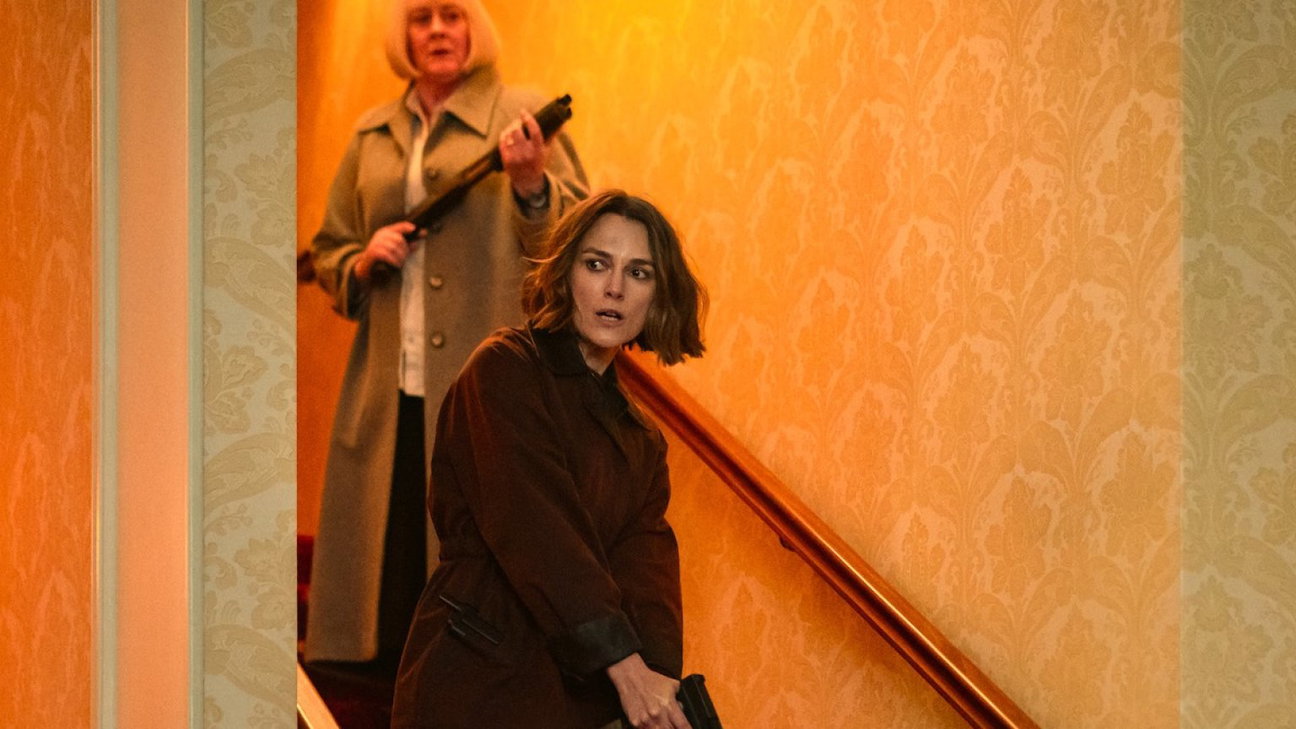
Their conflict is visible almost immediately. Helen has spent years surviving by reading people, managing appearances and keeping several versions of herself in circulation. She is married to a rising political figure who becomes prime minister, and her access to power is part of the value she brings to the Black Doves. Laila, by contrast, arrives with little patience for ceremony. She is a capable operative, but she does not seem particularly interested in making the job look respectable.
That difference gives their scenes a lively rhythm. Helen tends to approach a problem with calculation and a sense of what must be protected. Laila is more likely to say the rude thing out loud, question the plan and make a joke while the situation is still dangerous. The younger agent’s bluntness can look reckless; Helen’s composure can look entitled or over-managed. Neither woman is entirely wrong, and neither is entirely comfortable with what the other represents.
Radio Times reported that Mod sees a generational element in their relationship and said Laila enjoys roasting Helen. Mod also described the divide between them as a set of “gaps and divides” that becomes especially clear in their first scene together. Knightley, meanwhile, characterised Helen as “pure capitalist,” while Mod floated the idea that Laila might be “quite socialist” — before acknowledging that Laila is ultimately out for herself. Read the Radio Times interview.
The capitalist spy wife and the supposedly socialist assassin
The labels are deliberately playful, not a definitive political manifesto for either character. Helen’s relationship with capitalism is easier to identify through her position than through a speech about ideology. She works for a covert organisation that trades in intelligence and places agents close to powerful people. Her marriage gives her proximity to the centre of British government, and she knows how to turn that access into professional leverage. Her wardrobe, manners and public role are all part of a carefully maintained surface.
Laila appears to occupy a different cultural lane. She is scrappier in manner, less deferential and more openly suspicious of the social performance that surrounds Helen. Yet the show complicates any easy reading of her as an anti-capitalist rebel. Mod pointed to Laila’s designer clothes, trainers, spacious central London flat and drum kit. The character enjoys expensive things, and the actor herself joked that Laila may simply be out for herself. Her politics remain a question, not a settled fact.
That contradiction is useful. Laila can mock the privilege around Helen without being written as a pure ideological opposite. She is a mercenary, not a political organiser. Her apparent class critique comes through attitude, instinct and the way she reacts to Helen’s world, rather than through an explicit programme for changing it. The show leaves room for viewers to enjoy the joke while noticing that both women are operating inside a market for secrets and violence.

Helen’s polish is a survival skill, not just a personality trait
It is tempting to read Helen’s controlled manner as simple snobbery, especially when Laila needles her about being a spy wife. But Helen’s polish has a practical purpose. She has spent years building a convincing domestic and political identity while hiding her work as an intelligence operative. The performance is not an accessory; it is part of her cover.
Season 2 makes that performance more difficult. Wallace’s rise to prime minister moves Helen closer to the most scrutinised address in British public life. Her access grows, but so does the risk that a mistake will expose not only her but the organisation that employs her. Netflix’s official season guide describes Helen as continuing to pass secrets to the Black Doves while her husband’s political ascent places her in a more dangerous position. Netflix Tudum’s Season 2 guide lays out that pressure.
Helen’s instinct is to control the room because losing control can cost lives. Laila’s instinct is to challenge the room because she does not want to be managed by people who mistake status for competence. Their methods are different, but both are forms of self-protection. That is why their arguments have more texture than a simple older-versus-younger gag.
Laila’s irreverence is a weapon
Mod’s performance gives Laila a comic speed that changes the temperature of the series. She can be threatening without becoming solemn, and she treats the absurdity of her work as something worth pointing out. British GQ described her as the season’s standout new recruit, highlighting the way her flippant remarks and chaotic energy cut through the thriller’s violence. British GQ’s review argues that Mod’s comic timing is a major part of what makes the new season click.
That humour is not just decoration. Laila’s refusal to perform seriousness gives her a kind of freedom inside the organisation. She does not seem as invested as Helen in appearing respectable, and she can puncture the self-importance of people who expect deference. But the same attitude can make her difficult to predict. A colleague cannot always tell whether she is joking, testing them or preparing to act.
Mod has also said that Laila is confident because she knows she can take care of herself. In an interview with Stylist, the actor described her as honest, brash and unserious, while distinguishing that confidence from her own personality. Stylist’s interview with Ambika Mod offers a useful look at how she approached the role and its physical demands.
Class is present even when the characters are joking
The class tension between Helen and Laila is not delivered as a lecture. It appears in small signals: who is comfortable in a luxury setting, who treats expensive taste as normal, who is willing to mock the people with influence, and who has learned to make power look effortless. Helen has a political household to maintain and an organisation that values her access. Laila has the skills to be useful but does not appear eager to copy Helen’s manners.
There is a useful complication here: money and class are not the same thing as ideology. Laila’s taste for trainers, designer clothing and a large flat makes her hard to reduce to a working-class symbol. Helen’s privilege does not mean she is free from danger or emotional vulnerability. Both women have learned to survive in a system that treats people as assets, and both can be ruthless when their safety is threatened.
The series is at its sharpest when it lets those contradictions sit together. Laila can call out the absurdity of Helen’s status while enjoying the benefits of her own success. Helen can look like the establishment while knowing that her position is precarious. Their clash is funny because neither can claim the moral high ground for long.
Why their partnership matters to the season
Helen and Laila are not simply two characters thrown together to trade insults. Their uneasy partnership gives the season a new kind of energy. Helen has experience, connections and a long history with the Black Doves. Laila brings a different pace and an unpredictable approach. When they have to work together, each is forced to rely on someone whose instincts she does not fully share.
The contrast also expands the show’s picture of the organisation. The Black Doves are not a neat team of people with one outlook. They are a network of operators, handlers and executives whose interests overlap only when the job requires it. Netflix’s cast guide describes Laila as a quick-witted, chaotic operative who can disrupt a mission or save it. That description captures why she is both a useful ally and a source of friction.
In the finale, Laila’s involvement in the effort to rescue Reed puts her alongside Eleanor and Williams. Netflix’s ending explainer notes that working with the duo is new territory for a lone-wolf character who is used to handling things herself. Mod suggests that the experience may begin to lower Laila’s barriers. It is an important shift: the woman who mocks Helen’s carefully managed relationships may herself discover that relying on other people is not always a weakness.

What the clash says about the future of Black Doves
Their dynamic leaves the series with an appealing question: can an organisation built on buying and selling secrets make room for people who do not share the same values? Helen understands the institution from the inside and has invested much of her life in it. Laila is more difficult to contain. She can be effective without being obedient, and she may not be interested in the same rewards that keep other agents in line.
That does not make Laila a guaranteed reformer, any more than Helen is simply a symbol of establishment power. The show has not given viewers enough evidence to define Laila’s politics conclusively. What it has offered is a sharp contrast in temperament and worldview, with the possibility of deeper history still unexplored. Mod herself told Radio Times she would be interested in learning more about where Laila came from and why she operates as she does.
My reading is that the generational divide works because it is not a clean ideological split. Helen and Laila both know how to use people, both understand danger and both have a sense of humour that can turn cruel. Their differences are real, but the similarities are what make them potentially formidable together. If the series continues, the most interesting development would not be one woman converting the other. It would be both learning how to work with someone who refuses to become a copy of her.
Frequently asked questions
Why do Helen and Laila clash in Black Doves Season 2?
They have different personalities, professional instincts and social outlooks. Helen is polished and politically connected, while Laila is blunt, irreverent and less interested in status or ceremony. Ambika Mod has also described a generational divide between them.
Did Keira Knightley call Helen a capitalist?
In an interview reported by Radio Times, Knightley described Helen as “pure capitalist.” Mod joked that Laila might be “quite socialist,” while also noting that Laila is ultimately out for herself.
Is Laila really a socialist?
The series has not established that as a firm political identity. The description came up as a playful interpretation in an interview, and Mod acknowledged that Laila’s expensive tastes and self-interest complicate the label.
Who plays Laila in Black Doves?
Ambika Mod plays Laila Joshi, a sharp-tongued and highly capable operative who joins the story in Season 2.
What makes Laila different from Helen?
Laila is more openly irreverent and instinctive, while Helen is more controlled and accustomed to navigating political and institutional power. Both are capable agents, but they approach people and problems differently.
Do Helen and Laila become allies?
They work together during Season 2, including the effort to rescue Reed. Their relationship remains full of friction, but the shared danger creates room for greater trust.
Will Season 3 explain Laila’s background?
That has not been confirmed. Mod has said she would be interested in exploring Laila’s origins and motivations further, but no specific Season 3 storyline about her background has been announced.
Sources and further reading
- Radio Times: Keira Knightley and Ambika Mod on the gaps and divides between Helen and Laila
- Stylist: Ambika Mod on playing Laila and working with Keira Knightley
- British GQ: Why Ambika Mod is a standout in Black Doves Season 2
- Netflix Tudum: Black Doves Season 2 cast, story and production guide
- Netflix Tudum: Season 2 ending explained
By Shivam Das


