

Keira Knightley has given a simple explanation for why the action in Black Doves feels so distinctive: the fights are not a break from the show's identity. They are part of it. In a Press Association interview at the Season 2 launch in London on November 2, 2026, Knightley called the strange contrast at the heart of Helen Webb's life “the joy of the series.” Helen can move from the polished world of a politician's wife to lethal undercover work, then return to domestic life as if those identities belong in the same room.
That contrast is more than a clever character detail. It gives the Netflix spy thriller its particular rhythm: violence, dry humor, social performance and emotional danger can sit side by side. Knightley's comments also point to the care behind the choreography, especially the Season 2 sequence she shares with Ambika Mod's Laila.
Why Keira Knightley calls the fights the “joy” of Black Doves
Knightley's explanation was not simply that the action is exciting. She focused on the oddness of watching Helen perform the role of a respectable political spouse while secretly carrying out deadly work. The fight scenes make that contradiction physical. One moment, Helen is expected to look composed and reassuring; the next, she is navigating a room full of armed threats.
In the same interview, Knightley said it was important for the fight sequences to feel like a genuine part of the series. She also described the fun of working with Mod to make a fight look almost impossibly neat: the characters can take down multiple opponents without their hair, clothes or appearance showing the expected aftermath. That clean finish is deliberately absurd. It turns the polished image of the characters into part of the joke.
The comedy does not erase the danger. Instead, it sharpens the show's tonal balancing act. The audience can recognize that the characters are in real peril while also enjoying the precision and audacity of the set piece. That combination is one reason the action feels specific to Black Doves rather than interchangeable with a standard spy-thriller fight.

Helen and Laila make the contrast work on screen
Season 2 gives the action a new dynamic through Laila, played by Ambika Mod. She is not simply another operative assigned to help Helen. Her energy, blunt humor and physical confidence create a different kind of partner for Knightley's controlled, carefully guarded character.
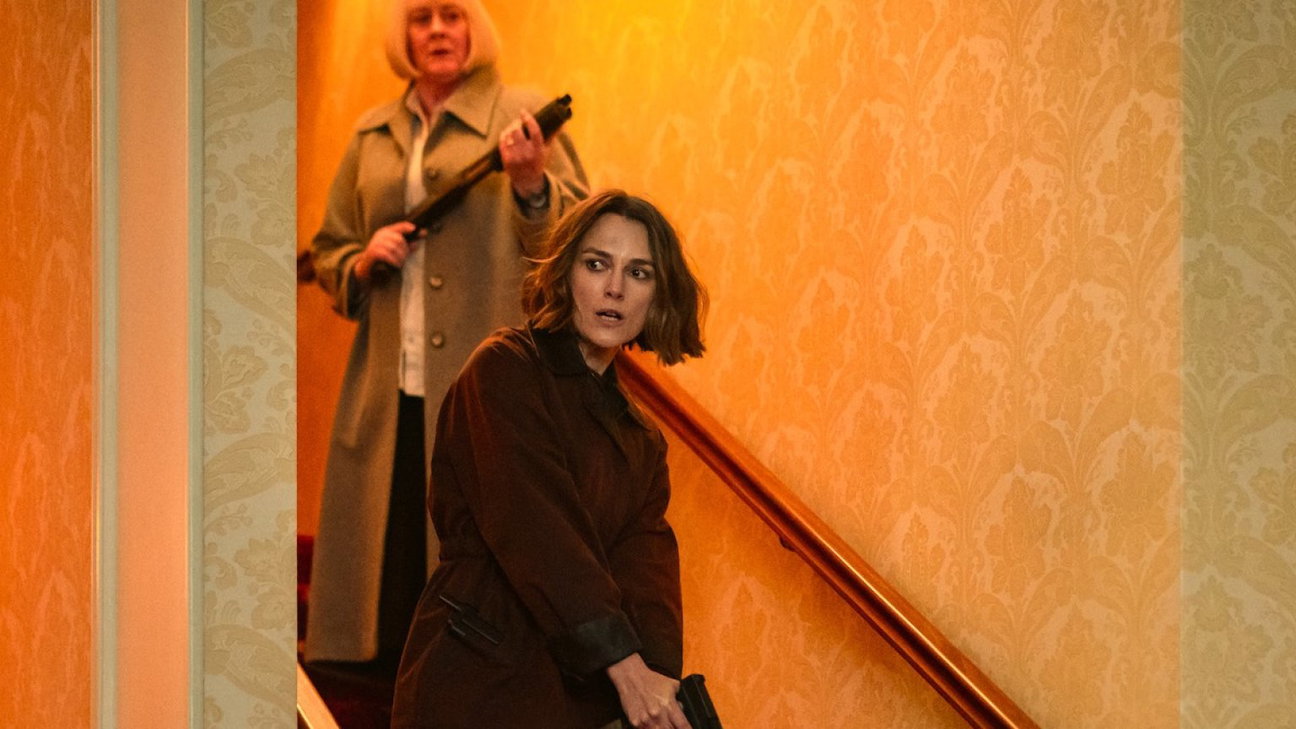
Their early fight sequence makes that pairing immediately legible. The two women have to move as a team, but their personalities do not suddenly become identical. The choreography gives each performer a distinct presence while making the partnership look coordinated. That matters because a good screen fight is not only a sequence of impacts; it is also a scene about who trusts whom, who takes the lead and how quickly two characters can read each other's choices.
Mod has spoken about how much she enjoyed the stunt work. In coverage of the Season 2 launch, she described the stunt experience as her favorite part of the production and said the choreography, training and fighting were new territory for her. The satisfaction, she explained, came from learning the movements and then seeing the finished sequence assembled on screen.
That enthusiasm is useful context for the chemistry viewers see. The action is not presented as Knightley doing everything while a partner simply follows. The sequence depends on two performers contributing different kinds of energy, with the stunt team shaping the movement into one readable piece of screen storytelling.
The choreography is built around the actors, not just the spectacle
Knightley has previously explained that her preparation for Black Doves involved boxing, jujitsu and Filipino knife-fighting techniques. In a Netflix Tudum interview, she credited stunt coordinator Sarah and fight coordinator Rob Cooper, explaining that the team watched how her body naturally moved and then built the fights around those instincts.
That approach helps explain why the action can feel fluid rather than overly mechanical. A performer can learn a sequence accurately and still look uncomfortable if the movement does not suit their physical habits. Building choreography around the actor gives the scene a more individual rhythm. It also gives the camera and editor clearer physical choices to follow.
Knightley said the training period was relatively short and that each fight was filmed in a single day. That compressed schedule makes the coordination especially important: the performers need to understand the sequence, the stunt team needs to keep it safe, and the production needs to capture enough usable angles without losing continuity.
Mod's experience adds another layer. For a performer who had not previously done this kind of stunt work, the process meant learning the movements thoroughly and then adapting when the practical realities of the set changed. That is part of why the finished action can look effortless even though it depends on rehearsal, timing and careful technical work.
Why the clean, almost-perfect finish is funny
The image of Helen and Laila leaving a fight with their hair and clothes still immaculate is funny because it clashes with what the audience has just watched. The scene asks viewers to accept an exaggerated action-movie fantasy, then pushes that fantasy one step further by preserving the characters' polished appearance.
It also says something about the world Helen inhabits. Her public identity is built on control: the right clothes, the right expression, the right response at the right event. The action sequences turn that public polish into a visual punchline. She can be involved in extraordinary violence and still appear to have stepped out of a formal engagement. That is not realism; it is the show's chosen style.
The joke works best when the choreography remains clear. If viewers cannot follow who is moving where, the humor disappears into noise. When the action is readable, the contrast becomes the point: the characters' physical competence is outrageous, but the performance of respectability is just as carefully maintained.

What the fight scenes reveal about Helen
Helen's violence is not presented as a separate personality that switches on and off without consequence. It is one part of a character who has learned to perform several versions of herself. The fight scenes make those versions collide in public view. Her polished appearance can be read as a survival skill, a disguise and, at times, a source of dark comedy.
Knightley's comments about the series' “complex creatures” underline that idea. The characters are not reduced to a single moral label. Helen can be a mother, a spouse, a spy and a highly capable fighter; those identities do not neatly cancel one another out. The show's tension comes from watching her try to keep them all in place when the consequences of her work become harder to contain.
That is why the action matters beyond spectacle. A well-designed fight can reveal a character's instincts faster than a long explanation. It shows how Helen reacts under pressure, how she uses the space around her and how much of her composure is genuine. With Laila beside her, the scenes also test whether Helen can work with someone whose methods and personality are not simply extensions of her own.
Why this action style helps Black Doves stand apart
Many spy dramas use fight scenes to raise the stakes or demonstrate a character's training. Black Doves does that, but it also uses action to express its unusual mix of menace and mischief. The series can stage a dangerous encounter and then find humor in the characters' immaculate presentation, their clipped reactions or the absurdity of the situation.
That tonal confidence is the real meaning behind Knightley's remark. The fights are not decorative interludes between plot developments. They are a way of showing the show's central contradiction: people can occupy several identities at once, and those identities can be both convincing and ridiculous. Helen's life as a political spouse and a covert operative is an extreme version of a familiar human truth — people behave differently in different rooms.
Season 2's expanded partnership with Laila gives that idea a fresh physical expression. Their fights are not only about who can win. They are about how two very different women coordinate, improvise and preserve their own personalities while moving through danger. That is what makes the action memorable, and why Knightley sees it as part of the series' core appeal.
The show's action language was established before Season 2
Season 2 builds on an action identity that was already visible in the first run. Earlier confrontations helped establish Helen's ability to move between ordinary surroundings and sudden, high-risk violence. The newer partnership with Laila changes the rhythm, but the underlying contrast — a composed exterior set against extraordinary danger — remains central to the series.
Quick answer: What did Keira Knightley mean by “the joy of the series”?
She was referring to the strange, entertaining contrast between Helen Webb's polished public role as a politician's wife and her secret life as a lethal operative. Knightley said the fight scenes are essential to that contrast, especially the deliberately immaculate look Helen and Laila can maintain after an outrageous action sequence.
Frequently asked questions
What did Keira Knightley say about the Black Doves fight scenes?
At the Season 2 launch in November 2026, Knightley said the strangeness of Helen being a politician's wife while also going off to kill people was “the joy of the series.” She also said the fight sequences were important to get right.
Who fights alongside Keira Knightley in Black Doves Season 2?
Ambika Mod, who plays Laila, shares a key action sequence with Knightley's Helen. Their partnership brings together Helen's controlled approach and Laila's more anarchic energy.
What training did Keira Knightley do for Black Doves?
Knightley has described training in boxing, jujitsu and Filipino knife-fighting techniques, with choreography developed around the way she naturally moved.
Why do Helen and Laila look so immaculate after fighting?
That polished finish is part of the show's deliberately heightened humor. It contrasts the violence of the action with the characters' composed appearance, rather than aiming for strict realism.
When did Black Doves Season 2 premiere?
Netflix's official Season 2 announcement listed November 5, 2026 as the release date.
Sources and further reading
- Press Association report via The Irish News: Knightley on why the fight sequences matter
- Netflix Tudum: Keira Knightley on Black Doves, fight training and choreography
- Radio Times: Ambika Mod on stunt training and the Somerset House sequence
- Netflix Tudum: Black Doves Season 2 release and cast information


