

Keira Knightley’s Helen Webb is not dangerous because she has learned to imitate a traditionally masculine action hero. She is dangerous because the series lets her be a complicated woman whose capacity for violence sits beside motherhood, political polish, friendship, fear and a very ordinary desire to keep her family intact. That tension is at the heart of Black Doves — and it gives Knightley’s observation about violence in women a sharper meaning than a simple sound bite.
In a recent interview about the second season, Knightley discussed the idea that women’s capacity for violence is often underexplored on screen. The Times framed the conversation around the line “There Is Violence in Women,” while Knightley also described enjoying the challenge of playing a power-hungry, morally ambiguous character. The important point is not that the show argues women are secretly more violent than men. It is that Helen’s violence is treated as part of her character rather than as an exception that needs to be explained away.
What Knightley’s comment says about Helen Webb
Helen is introduced as a political wife who can move comfortably through rooms where appearances matter. She is also a covert operative who has spent years passing sensitive information to the Black Doves. Those identities are not separate compartments. Each one changes how the other works: her public respectability gives her access, while her secret work makes the domestic life she presents increasingly fragile.
That contradiction is what makes her violence unsettling. Helen can make a decision with lethal consequences and then return to the routines of family life. The show does not ask viewers to mistake that ability for emotional strength or moral clarity. Instead, it makes the gap between her roles part of the drama. She can be protective and frightening, loving and calculating, vulnerable and capable of frighteningly decisive action.
In its official Season 2 character guide, Netflix describes Helen as a devoted mother, polished political spouse and covert operative whose roles are becoming harder to keep apart. That description is a useful starting point: the character is not simply an assassin wearing a mother’s costume. The pressure comes from all of those parts being real at the same time.
Violence without the familiar action-hero disguise
Action stories have often treated male violence as a genre default: a man can be brutal and still be framed as competent, damaged, righteous or cool. Women who use violence have more frequently been pushed toward a narrower set of explanations — revenge, trauma, seduction, madness or an unusually masculine persona. Helen does not fit neatly into any one of those boxes.
Her violence is practical, sometimes impulsive, sometimes strategic, and often morally compromised. It is also connected to the systems around her. She works for an organisation that trades in secrets and treats people as assets. She lives close to political power. She has been trained to assess threats quickly. Those circumstances do not excuse what she does, but they help explain how the character has learned to move through danger.

The distinction matters. If the series presented Helen as a flawless action machine, the violence would become a stylish accessory. Instead, her choices carry consequences into her marriage, her work and her friendships. The action can be witty and fast-moving, but the emotional cost remains visible beneath the choreography.
Why motherhood makes the character more complicated, not less
Helen’s children are not a sentimental detail added to soften a killer. They are among the people most exposed to the danger created by her double life. Her instinct to protect them is genuine, but the methods available to her are shaped by years of secrecy and violence. That is a much more uncomfortable dramatic question than whether a mother can also be an assassin.
The second season intensifies the collision between those roles. Wallace’s political rise brings the family closer to public scrutiny, while the threats around the Black Doves make private life harder to defend. Netflix’s official synopsis describes Helen as walking a more treacherous line as Wallace prepares to become prime minister. The family home is no longer a reliable boundary between the person Helen presents and the operative she has become.
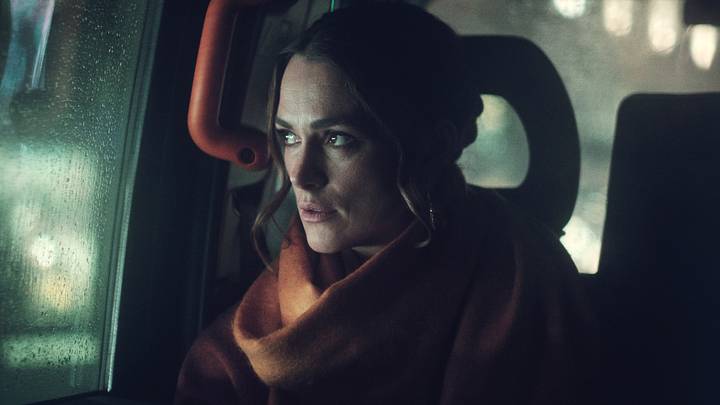
Motherhood also complicates the audience’s response. Viewers may understand why Helen wants to keep her children safe without accepting every choice she makes in pursuit of that goal. The show is at its strongest when it allows both reactions to exist together. Love can motivate protection, but it can also become the justification a character uses to avoid facing the harm she has caused.
Knightley’s performance keeps Helen from becoming a symbol
There is a risk in discussing a character like Helen only as a statement about gender. That can flatten a specific person into an argument. Knightley’s performance avoids much of that trap by giving Helen contradictions that do not resolve into a tidy message. Her stillness can look like control; a quick joke can conceal panic; a moment of tenderness can sit uncomfortably close to a ruthless decision.
That layered approach is consistent with Knightley’s comments to Netflix Tudum about Helen being a mystery even to the actor playing her. In the earlier interview, Knightley described the character’s backstory as something she and director Alex Gabassi worked through in order to understand the damage that shaped her. The point is not to turn that damage into a diagnosis. It is to show how a person’s history can inform behaviour without making every action inevitable.

Her work also gives the action scenes a particular texture. Helen is not invulnerable. She can be hurt, surprised and pushed into decisions she would rather avoid. The physicality is convincing because the character is not detached from the consequences of using it. The violence belongs to a person, not just to the set-piece.
The show’s gender politics are strongest when they stay complicated
Knightley has suggested that the series was not designed as a deliberate manifesto about gender. That distinction is worth keeping. A story does not need to announce a political thesis to reveal something about the assumptions built into a genre. By placing a woman at the centre of a spy thriller and refusing to make her violence either uniquely monstrous or automatically empowering, Black Doves opens space for a more complicated conversation.
It also avoids a simplistic reversal in which women’s violence is presented as inherently more justified. Helen’s actions can be effective and still be wrong. Her reasons can be understandable and still be self-serving. The series does not ask the audience to applaud every act simply because a woman performs it. That refusal to offer easy absolution is part of what makes the character compelling.
There is another useful contrast in the show’s ensemble. Helen’s work is surrounded by other women with very different relationships to power, loyalty and violence, including Reed, Laila, Eleanor and Williams. They are not interchangeable examples of a single idea. Their motives, methods and vulnerabilities differ. The world feels richer because women are allowed to occupy several moral positions rather than being divided into the innocent and the dangerous.

What the second season leaves viewers thinking about
Season 2 raises the stakes around Helen’s work and her family, but its most interesting question is not whether she can win another fight. It is whether she can live with the person she has become when the people closest to her begin to see more of the truth. The series has spent two seasons showing how effectively Helen can compartmentalise. The pressure now comes from those compartments breaking down.
That is why the idea of violence in women lands most forcefully when it is attached to character rather than slogan. Helen’s capacity for violence is not a twist that makes her less of a woman, nor is it proof that she is somehow liberated from ordinary moral limits. It is one part of a life built around secrecy, fear, ambition and love — and one part that has consequences for everyone around her.
Knightley’s performance gives the character room to be unsettling without turning her into a caricature. Helen can be funny, protective, frightened, manipulative and lethal. The show’s achievement is not that it makes all of those qualities fit comfortably together. It is that it makes the discomfort impossible to ignore.
Frequently asked questions
What does Keira Knightley mean by “There Is Violence in Women”?
The phrase points to how women’s capacity for violence is often underexplored in screen stories. In the context of Black Doves, it opens a discussion about Helen Webb as a woman whose violent work exists alongside motherhood, intimacy and political life. It should not be read as a claim that women are naturally more violent than men.
Is Helen Webb a villain in Black Doves?
Helen is a morally complicated protagonist, not an uncomplicated hero or a conventional villain. She protects people she loves, but she also lies, kills and makes choices that put others at risk. The tension between those actions is central to the series.
Who plays Helen Webb?
Keira Knightley plays Helen Webb in Netflix’s Black Doves. Netflix’s Season 2 cast guide identifies Helen as a covert operative whose public role as a political spouse and private role as a mother are increasingly difficult to keep separate.
Does Black Doves treat Helen’s violence as empowerment?
Not simply. The series gives Helen agency and physical capability, but it also shows the damage and moral compromises attached to her decisions. Understanding her motives does not require approving of everything she does.
Where can viewers watch Black Doves Season 2?
Black Doves Season 2 is streaming on Netflix. Netflix’s official Season 2 guide lists the returning cast and confirms the season’s release on November 5, 2026.


