

There is a reason the fights in Black Doves feel less like polished choreography and more like trouble arriving before anyone has time to think. The production did not have the luxury of spending a week on every clash. In a Netflix interview, Keira Knightley said the fight scenes were each filmed in a single day — an unusually compressed schedule for action work. That detail helps explain the series’ physical urgency, but the more interesting story is how the stunt team made speed serve character rather than simply making the schedule look impressive.
Knightley described a preparation period of roughly a month, with two or three training sessions a week. The work included boxing, elements of jiu-jitsu and Filipino knife-fighting. Fight coordinator Rob Cooper, she said, watched how she naturally moved and shaped the choreography around her body. Instead of asking an actor to imitate a generic action style, the team built sequences around movement she could perform convincingly.
That approach matters because screen combat is not just a list of punches and falls. It has to feel like something this particular character would do, under pressure, in this particular space. The result is action that looks urgent without asking the audience to forget the person inside the fight.
The one-day schedule behind the fights
Knightley’s most striking production detail was the time available on set. She said each fight scene was shot in one day, contrasting that with a feature-film action sequence that might commonly take three days to a week. The comparison is her account of the production, not a universal rule for every film or television shoot. Still, it makes clear how quickly the Black Doves team had to work.
A one-day shoot changes the pressure on every department. Performers need to know their movement. The stunt team has to make the sequence safe and repeatable. Camera, lighting, props, costume and direction must be ready to capture the action without wasting the limited time. A complicated move that looks spectacular in rehearsal may have to be adjusted if the location, camera angle or available space makes it impractical.
That is not the same as making the action careless. The best way to move quickly is to do the detailed work earlier: establish the sequence, rehearse the transitions, understand the space and decide which movements are essential to the story. Knightley’s comments suggest that preparation and individualized choreography were central to making the compressed schedule workable.
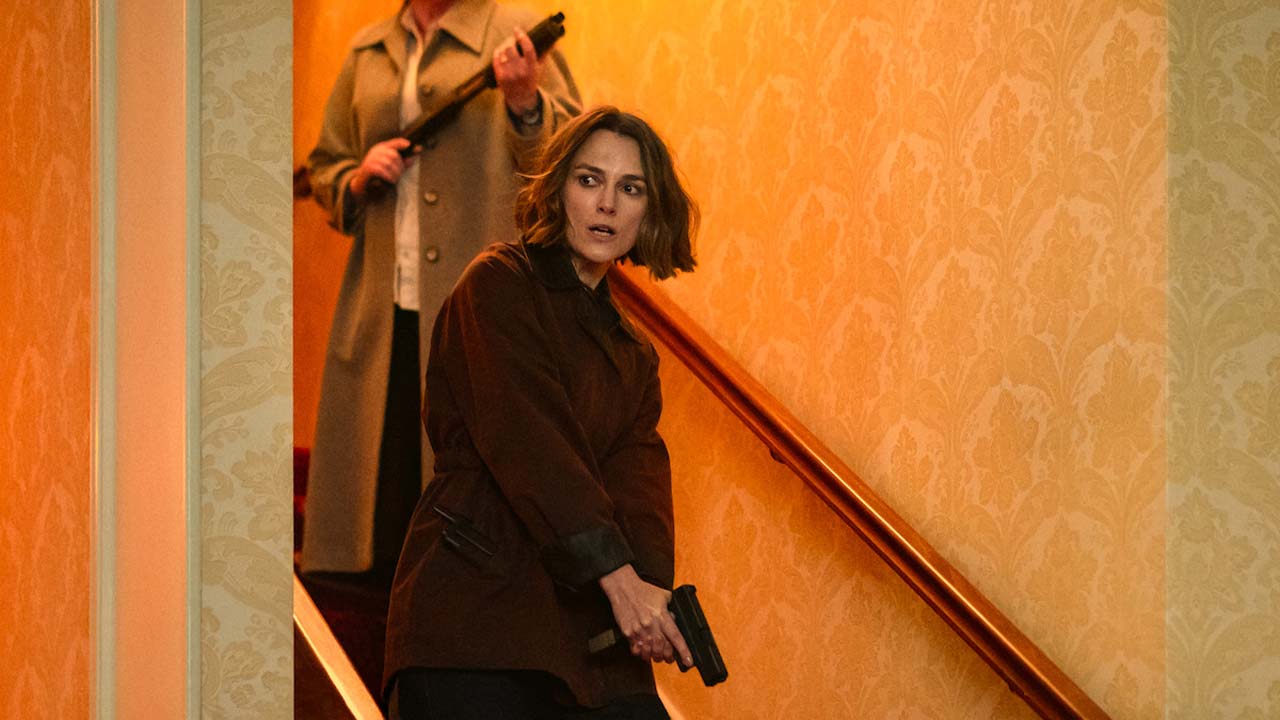
Why choreography was built around Knightley’s movement
One of the most revealing parts of Knightley’s interview was her description of how Cooper approached the training. The team did not simply hand her a fixed sequence and expect her to reproduce it. He observed how she moved, then developed fights that suited those instincts.
That approach can make screen combat feel more believable. Every performer has a different reach, balance, rhythm and level of comfort with particular movements. Choreography that respects those differences can look more fluid than a sequence built around technically impressive actions an actor cannot perform naturally. It also gives the character a physical identity. Helen Webb is not presented as an anonymous superhero; she is a woman whose survival depends on speed, instinct and a willingness to use whatever advantage is available.
There is an important distinction between looking effortless and being unprepared. A fight can appear spontaneous on screen precisely because the performers and crew have rehearsed the timing. The audience sees the impact and confusion, not the careful planning that makes the sequence repeatable.

Why the fights feel raw instead of glossy
The production’s wider creative philosophy helps explain the physical texture. In a behind-the-scenes account for the Royal Television Society, directors Alex Gabassi and Lisa Gunning discussed wanting the fights to feel visceral and emotionally connected rather than overly flashy. Gunning described the idea as “epic intimacy”: large-scale action still needed to feed the emotional life of the characters.
That principle matters. A fight is not automatically compelling because it contains more punches, more cuts or a bigger stunt. It becomes memorable when the action reveals something: fear, desperation, anger, exhaustion or the cost of a decision. A character who is fighting to escape should not move like someone performing a victory lap. The choreography, camera placement and aftermath all need to support the same emotional idea.
The directors also emphasized the ordinary objects and domestic spaces that can become part of a struggle. In the series, the environment is not merely a background. A room, a piece of furniture or an object within reach can change what a character is able to do. That makes the action feel scrappy and immediate, as though the fight has broken into a real place rather than taking place on a purpose-built arena.
The jewelry-shop fight with Dani: a different kind of challenge
Knightley singled out Helen’s fight with Dani, played by Agnes O’Casey, in the jewelry shop in Episode 5. She recalled that the sequence was the most settled of the fights. The other two changed considerably because of the locations in which they were filmed; the Dani confrontation was shot in a studio, giving the team more control over the space and the opportunity to decide what worked best.
That contrast is useful for understanding action production. A studio can offer greater control over the layout, camera positions and repeatability of movement. A location can bring atmosphere and visual authenticity, but it can also impose restrictions that force a sequence to change. Neither approach is automatically better. The right choice depends on what the scene needs to communicate and what can be achieved safely.
Knightley also joked about wanting Helen to kill Dani because of the character’s history with her husband. The comment gives a glimpse of the actor’s playful relationship with the character, but it also points to the emotional fuel beneath the choreography. Helen’s fights are not detached displays of technique. Personal resentment, fear and loyalty can all be present in the way she confronts someone.

What the stunt team contributes beyond the visible moves
Audiences tend to notice the performer at the center of a fight, but the finished sequence is a team achievement. The stunt coordinator and fight coordinator help design and rehearse movement. Performers learn timing and physical cues. Directors decide how the action should feel. Camera and editing determine what the audience can understand, while props and effects help sell contact without exposing performers to unnecessary risk.
For Black Doves, the practical-effects work also matters to the world of the show. The effects company Artem lists soft props, breakaway doors, silicone blood effects, retractable blades and other practical elements among its work on the series. Those details help create the impression that violence has consequences in the physical environment. They are part of the craft behind the image, not evidence that an actor is actually experiencing the impact shown on screen.
How Season 2 builds on the action language
The one-day fight-shooting detail comes from Knightley’s discussion of the original season’s action work. It should not be misrepresented as a confirmed production schedule for every Season 2 fight. Season 2 does, however, continue to put Helen and Sam in situations where action is tied to trust, loyalty and the cost of their work.
In interviews around the second season, Knightley and Ben Whishaw spoke about the new episodes’ action set pieces, while Netflix’s official material describes the story as pushing the pair deeper into the dangerous world of the Black Doves. The broader lesson from the earlier production account still applies: the most effective action is not simply a matter of scale. It needs to tell us who these people are when the plan collapses.
Season 2 also expands the world around the central duo, adding new characters and locations. That creates opportunities for different kinds of action: a chase through a public space has different demands from a close-quarters confrontation, and a rescue sequence has a different emotional shape from a personal fight. The series works best when those differences are visible rather than making every set piece feel interchangeable.
Why a short shoot can create a sharper screen experience
A compressed schedule is not inherently a creative advantage. It can put pressure on a production and leave less room for experimentation. But when the preparation is strong and the choreography is tailored to the performer and location, the limits can encourage direct decisions. The team has to identify what the scene needs, what the space allows and which movements communicate the story most clearly.
That may be why the fights in Black Doves often feel messy in a purposeful way. The characters are not moving through a clean demonstration. They are trying to survive, protect someone or get out of a situation that has turned against them. A little awkwardness, a sudden change of direction or the use of an ordinary object can make the action feel connected to the world of the story.
The strongest takeaway from Knightley’s account is not simply that the crew worked fast. It is that the speed was supported by preparation: a month of training, a coordinator who adapted the movement to the actor, and a production team willing to adjust choreography to the realities of each location. The result is action that feels personal rather than mechanically impressive.
Quick answer: Were the Black Doves fight scenes filmed in one day?
According to Keira Knightley’s December 2024 interview with Netflix Tudum, each of the fight scenes she discussed for the first season was filmed in one day. She said she had about a month of preparation, with two or three training sessions per week, including boxing, jiu-jitsu and Filipino knife-fighting elements. The detail applies to her account of those Season 1 fight scenes; it should not be treated as a confirmed schedule for every action sequence in Season 2.
Frequently asked questions
How long did Keira Knightley train for Black Doves?
Knightley said she trained for about a month, with roughly two to three sessions each week. Her preparation included boxing, elements of jiu-jitsu and Filipino knife-fighting.
Who helped create the Black Doves fight choreography?
Knightley identified stunt coordinator Sarah and fight coordinator Rob Cooper as part of the preparation. She specifically credited Cooper with training her and adapting the fights to the way she naturally moved.
Were all the fights filmed in a single day?
Knightley said each fight scene she discussed was shot in one day. That is her account of the Season 1 production, not a blanket statement about every scene across both seasons.
Why did the jewelry-shop fight with Dani feel different?
Knightley said it was the most settled fight and was filmed in a studio. The other fights changed more because of the locations where they were shot.
Why does Black Doves use practical-looking action?
The directors have described wanting action that feels visceral and emotionally meaningful rather than merely flashy. The series also uses practical props and effects to make confrontations feel connected to the spaces around the characters.
Does the one-day filming detail apply to Season 2?
Not based on the interview cited here. Knightley’s one-day comment refers to the fight scenes she discussed from Season 1. Season 2 has its own action sequences, but the same schedule has not been established by that quote.
Sources and reporting: This article draws on Keira Knightley’s interview with Netflix Tudum, the Royal Television Society’s behind-the-scenes report on the series, Artem’s practical-effects project notes, and Netflix’s official Season 2 information. Production details are attributed to the people and organizations that reported them; interpretation of how those choices affect the finished action is analysis.


