

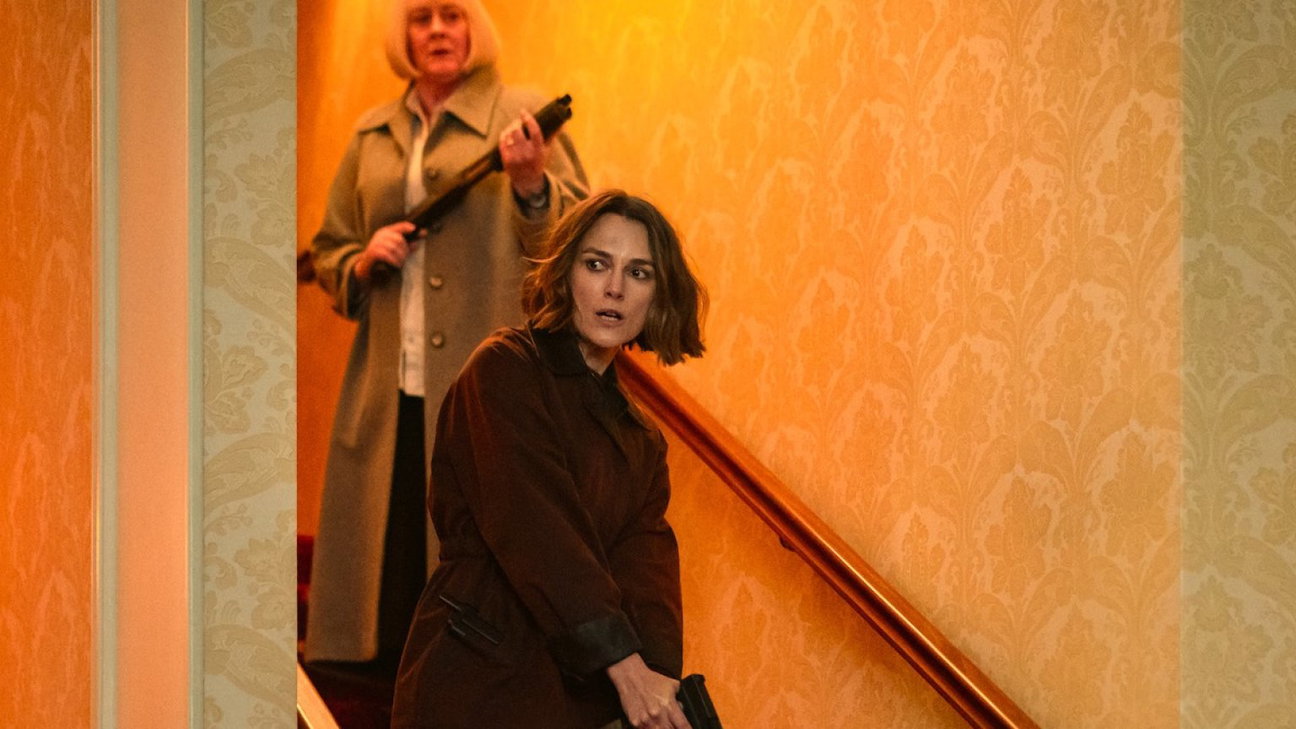
The fight in Black Doves that leaves Helen Webb and Laila Joshi looking almost impossibly composed is funny for a reason: the show knows exactly how ridiculous its own premise is. Two women can move through a room full of armed men, dispatch one threat after another, and emerge with their hair, clothes and professional poise apparently untouched. The joke is not a mistake in the action. It is the point.
Keira Knightley has spoken about the pleasure of that contrast. Discussing the series with the Press Association, she recalled how she and Ambika Mod enjoyed working out how their characters could take down so many opponents without getting blood on their clothes or disturbing their hair. That comment gets to the heart of the show’s action-comedy grammar: the violence is heightened, but the characters treat it like another demanding item on a very full working day.
The joke is in the contrast, not just the body count
Helen is not introduced as a conventional action hero. She is also a spouse, a parent, a public figure and a covert operative. The tension between those identities gives even a slick fight an extra layer. The immaculate appearance is a visual shorthand for the life she is trying to keep under control. A fight can be chaotic; Helen’s public mask is supposed to remain intact.
That contrast explains why the sequence feels so satisfying. The show does not ask viewers to believe every encounter is a realistic account of violence. Instead, it builds a stylised rhythm: a threat appears, Helen and her partner read the room, a practical object becomes useful, and the scene turns into fast-moving physical problem-solving. The fun comes from watching the characters stay resourceful while the situation becomes increasingly absurd.

Why Helen and Laila make such an effective screen partnership
Helen’s control and Laila’s more openly anarchic energy create a useful mismatch. Knightley’s performance often makes Helen look as if she is trying to keep several conversations, identities and emergencies running in parallel. Mod gives Laila a sharper, more impulsive edge. The pair do not need to behave alike to work together; their differences create the timing.
Mod has described the physical work as a major attraction of joining the series. In an interview with Radio Times, she recalled stunt training and singled out the Somerset House sequence as a favourite: the characters move through an art exhibition, using whatever is within reach as the action unfolds. She also said she and the other performers did much of the stunt work themselves. That preparation matters because the comedy depends on clarity. Viewers need to understand who is moving, what has changed, and why the next beat is funny.
The choreography has to look effortless because it is not
Good screen fighting is a designed sequence of positions, timing, reactions, camera placement and safe distances. The audience should feel the speed without seeing the planning. When a fight is staged as continuous movement through a location, the performers have even less room to hide a reset or a missed cue.
The Somerset House set piece illustrates that ambition. Knightley later described the surprise of being told the sequence would be filmed as a oner, despite limited rehearsal time. She recalled that the team managed to complete it in five takes. The finished scene’s breezy confidence is the result of coordination, not casual improvisation.
Everyday objects make the action feel playful
One reason the fights are memorable is that the environment is not just background decoration. An exhibition space, a corridor or a stairwell changes what the characters can do. A tray, a bottle or a fire extinguisher can become part of the choreography. These choices give the action a physical personality and help distinguish it from a generic exchange of gunfire.
They also reinforce the series’ dark comic tone. The characters are not pausing to admire the elegance of the setting; they are trying to survive inside it. The audience, however, can enjoy the absurd collision between a refined public space and the messy business of espionage. The contrast is especially sharp when the characters return to composed expressions as though the interruption has barely inconvenienced them.

The polished look is part of Helen’s character
It would be easy to treat the spotless clothes as a continuity gag and leave it there. But Helen’s appearance is tied to the performance she gives the world. She has spent years making different versions of herself coexist: the wife, the mother, the political hostess and the operative. Her clothes and posture help maintain that separation. The action scenes briefly threaten to expose the seams, then turn the near-impossibility of keeping everything neat into a running joke.
That does not mean the show is claiming violence has no consequences. The wider story repeatedly shows the emotional and political cost of Helen’s double life. The immaculate action is a stylised surface; beneath it sits a character whose choices keep becoming harder to contain. The contrast between polished presentation and moral disorder is one of the show’s most effective recurring ideas.
Why the scene works beyond the spectacle
The sequence lands because it serves several purposes at once. It gives the audience a burst of kinetic action, establishes the chemistry between Helen and Laila, and reminds us that Black Doves is not interested in solemn spy-thriller realism all the time. It wants danger and wit to occupy the same frame.
There is also a character point hidden inside the joke. Helen’s composure is both a strength and a burden. She is trained to stay functional under pressure, but she is also someone who has learned to hide the evidence of what she does. When she and Laila emerge looking pristine, the image is funny because it is exaggerated — and revealing because it resembles the impossible standard Helen sets for herself.
For more on the series’ action and locations, see our related coverage: Keira Knightley and Ambika Mod’s Clean Fight and the unfinished threads that shape the story’s future.
Frequently asked questions
Why do the Black Doves fight scenes look so clean?
The clean look is a deliberate stylistic choice. It heightens the contrast between the characters’ elegant public lives and the violence of their covert work, while giving the action a darkly comic edge.
Did Keira Knightley and Ambika Mod perform their own stunts?
They undertook stunt training and performed much of the physical work themselves, according to cast interviews. Specialist stunt teams still design, coordinate and supervise action safely.
What makes the Somerset House fight memorable?
Its movement through a real gallery setting, its use of objects in the environment, and the reported one-take approach give it a distinctive rhythm. Ambika Mod has named it among her favourite stunts.
Is the spotless appearance meant to be realistic?
No. It is heightened visual comedy, not a claim about how real fights unfold. The polished look is part of the show’s particular blend of espionage, action and absurdity.
Reporting and source notes: This article draws on Keira Knightley’s comments to the Press Association as reported by The Standard, Ambika Mod’s interview with Radio Times, and Netflix Tudum’s Season 2 locations guide. Interpretive comments about character, tone and visual style are analysis.


