

One of the smartest choices in Black Doves is also one of its least showy: Williams and Eleanor sound like people who come from somewhere. Ella Lily Hyland plays Williams with her native Irish accent; Gabrielle Creevy gives Eleanor a distinctly Welsh voice. Neither character is asked to sand down those differences into a generic television version of Britishness. Instead, creator and writer Joe Barton lets their voices become part of their chemistry, their comic timing and the way they occupy a scene.
That decision matters because Williams and Eleanor are not simply two assassins who happen to work well together. They are sharply drawn characters with separate rhythms, instincts and emotional defenses. Their partnership is funny because they do not always approach danger in the same way. It becomes affecting because, beneath the banter, each recognizes something in the other that the rest of their violent world rarely offers: a person who understands them without demanding that they become someone else.
Why the Irish and Welsh accents feel like character, not decoration
Hyland has spoken about how meaningful it was to perform Williams in her own Carlow accent. She described growing up without often hearing her own accent represented on screen and said it felt special to be allowed to keep it. Creevy has made a similar point about Eleanor: using her own Welsh voice felt freeing after years in which actors can feel pressure to alter how they speak for a role.
Those comments are more than publicity-friendly anecdotes. Accent is one of the ways a character carries a personal history into a scene. It affects pace, emphasis, humor and the small choices an actor makes when a line can be delivered several different ways. When Williams and Eleanor speak, the audience hears two distinct performers and two distinct characters. Their voices are not interchangeable, and that difference helps the partnership feel specific.
The effect is particularly useful in a spy thriller. The genre is full of aliases, covers and people pretending to be someone else. A character's voice can become one of the few things that feels stubbornly personal. Barton and the performers allow that personal quality to remain audible even when the characters are operating in a world built around deception.
Joe Barton’s writing starts with people, not just plot functions
In a Netflix Tudum interview, Barton explained that Williams was initially imagined as a Season 1 antagonist driven by revenge against Sam after he killed her previous partner. He had hoped Gabrielle Creevy would play Williams, but when Ella Lily Hyland proved such a strong fit for the role, the creative plan shifted: Barton created Eleanor as a new character for Creevy. When the two actors read together, he saw the possibility of a small, combustible team.
That behind-the-scenes detail helps explain why the duo feels so naturally matched without being written as copies of one another. Williams began with a harder, more revenge-focused dramatic purpose. Eleanor arrived as a fresh character whose energy could challenge and complement her. Their partnership was not simply a matter of giving two assassins the same jokes and the same attitude. The writing gave them room to become a pair through contrast.
It is also a reminder that character creation is often responsive. A writer may begin with a clear idea, then discover something unexpected when actors bring their own instincts, voices and chemistry to the material. In this case, the casting change did not merely fill a role; it opened up a relationship that became one of the series’ most distinctive elements.
Williams: dry wit, control and a buried need for connection
Netflix describes Williams as dry-witted and difficult to rattle, a killer who often sees a situation more clearly than the people around her. That description captures her surface, but Season 2 makes the surface less complete. Hyland has talked about Williams beginning to realize that she cares about people and may not be as emotionally detached as she once appeared.
That shift is not a sudden personality transplant. Williams remains blunt, pragmatic and capable of violence. What changes is the amount of emotional information the audience can see beneath those habits. Her jealousy, awkward confidence and directness around Eleanor expose a person who is not accustomed to negotiating intimacy. She can make a decision under pressure; admitting what she feels is another kind of risk.
Hyland’s performance makes that contradiction funny rather than sentimental. Williams can be emotionally exposed and still approach the situation with the practical logic of someone preparing a mission plan. The comedy comes from the mismatch between the scale of the feeling and the almost administrative way she tries to manage it.
Eleanor: openness that can be both strength and liability
Creevy describes Eleanor as someone who is open, and whose openness can get her into trouble. That quality gives her a different relationship to the world than Williams. Eleanor is brash, funny and unusually unfazed by violence, but she is not simply a louder version of her partner. Her willingness to say what she thinks can puncture the evasions that keep other people safe.
Her Welsh voice is part of that directness. Creevy has described the experience of using her own accent as freeing, and the series benefits from allowing that sound to remain part of Eleanor's identity. It gives the character a grounded specificity without reducing her to a regional stereotype. The writing lets her be sharp, vulnerable, absurd and dangerous in the same episode.
That range is important because Eleanor's emotional journey is not identical to Williams's. She can recognize the connection between them and still hesitate to name what it means. Creevy has suggested that Eleanor is not entirely unaware of her feelings; she is avoiding what acknowledging them might require. Her humor can be a way of approaching the truth while keeping a little distance from it.
The chemistry is built from difference and mutual recognition
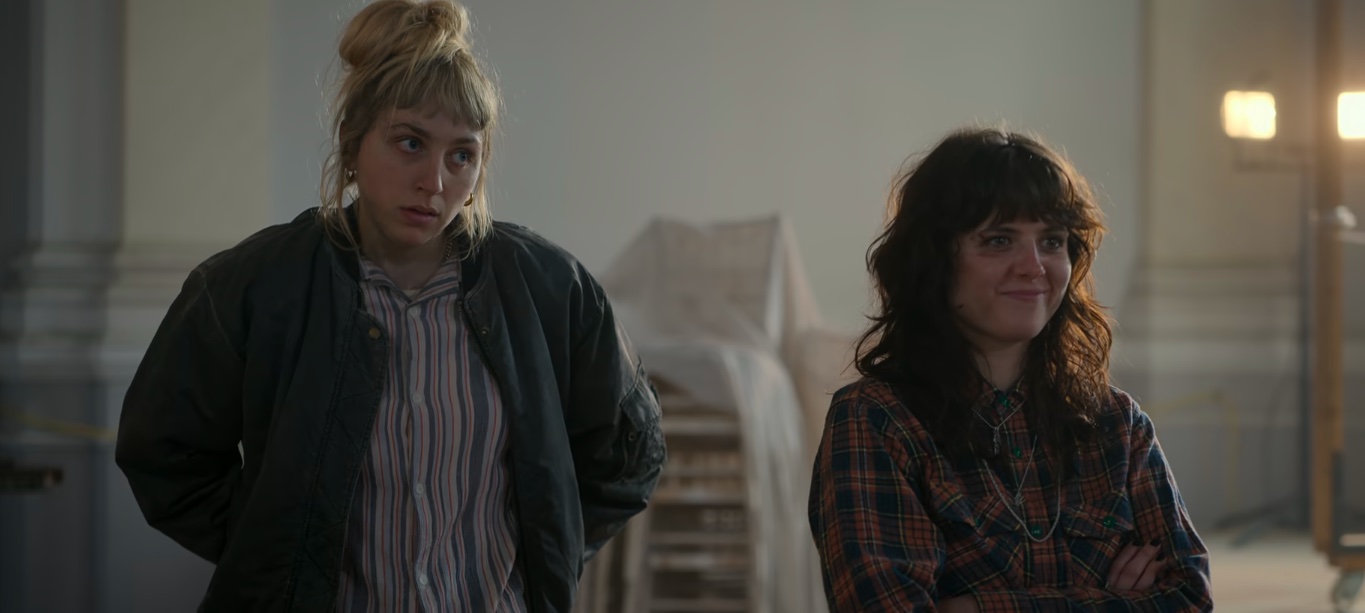
In the Tudum interview, Creevy and Hyland both pointed to humor and understanding as reasons the pair work together. They also discussed how their Irish and Welsh accents contribute to the connection. Hyland described Williams and Eleanor as almost one entity from Williams's perspective; Creevy called Williams a kind of home for Eleanor, someone who understands her humor and sees her clearly.
That is a useful way to understand the relationship. Their connection does not depend on one character rescuing the other from a dangerous profession. They already know the danger. What they offer each other is recognition: a person who can follow the joke, understand the instinct and see the vulnerability without requiring a long explanation.
The writing also avoids making the relationship feel like a pause from the action. Their most personal conversations happen in the middle of danger, including moments under gunfire and during a shoot-out. The contrast is absurd, but it is also true to the world of the show. These characters do not have the luxury of stepping outside their lives to discuss feelings in a calm, protected room. Emotional honesty arrives in the spaces their work leaves open.
How the show avoids turning female assassins into a single stereotype
Action television has often treated women in violent roles as variations on a narrow set of archetypes: the ice-cold professional, the seductive manipulator, the traumatized avenger or the unstoppable fighter. Williams and Eleanor borrow pieces of familiar spy-fiction language, but the writing does not stop there. Their humor, regional identities, awkwardness, loyalty and emotional uncertainty make them more individual than the job description.
That distinction is especially important when the characters are allowed to be funny. Their comedy is not a signal that they are harmless, nor does it excuse the violence they commit. It is part of how they move through the world. They can be lethal and ridiculous, confident and insecure, professionally capable and personally inexperienced. Those combinations feel closer to human contradiction than to a tidy action-hero template.
Hyland and Creevy have praised Barton for writing women who do not have to fit outdated boxes. The point is not that the characters are beyond criticism because they are women or because their voices are authentic. It is that the writing gives them room to be specific people before it asks the audience to judge them as assassins.
Season 2 turns the partnership into an emotional story
Season 2 makes the relationship more explicit without removing the qualities that made it entertaining. Netflix's official interview with the actors describes a slow-burn shift from partners in crime toward something more personal. Williams's feelings surface in a moment of danger; Eleanor takes longer to acknowledge her own, and the story lets the emotional development unfold through the same banter and chaos that defined their partnership.
Joe Barton has explained that he found the tension interesting because the characters are business partners whose feelings complicate the work. That is a particularly apt fit for Black Doves, a series in which strong attachments repeatedly become liabilities. The show does not pretend that love makes the danger disappear. It gives the characters another reason to take risks and another person whose safety matters.
The result is not a conventional romance inserted into an action show. It is a relationship shaped by the show's existing rules: danger interrupts intimacy, jokes cover fear, and trust has to be earned in a world where nearly everyone has a secret. The romance feels like an extension of the characters rather than a detour from them.
What authentic voices add to the wider Black Doves world
Helen and Sam may anchor the series, but the world becomes more convincing when the supporting characters do not sound as though they were written from the same template. Williams and Eleanor bring a different rhythm to the show. Their voices, comic timing and contrasting approaches to danger widen the emotional and cultural texture of the ensemble.
Authenticity here does not mean that every line is a documentary record of how people speak in a particular place. It means the production respects the performers' own voices and uses them as creative material. Hyland and Creevy have both described the value of not having to disguise their accents. That choice gives the characters a stronger sense of identity and helps viewers distinguish them even before the plot explains their histories.
It also offers a broader lesson about representation: a character does not need to be softened, simplified or made respectable to be recognizable. Williams and Eleanor are assassins. They are also Irish and Welsh women with their own humor, habits and ways of connecting. The show lets all of those things coexist.
Why Williams and Eleanor stand out
The appeal of Williams and Eleanor comes from the balance between craft and surprise. Barton’s writing gives them distinct dramatic functions and a shared comic language. Hyland and Creevy bring their own voices and instincts to the roles. The series then allows the relationship to evolve in ways that feel discovered rather than mechanically announced.
That is what makes the title idea—Irish assassins done right—more than a slogan. The characters are not memorable simply because one is Irish and one is Welsh. They are memorable because those identities are allowed to be part of a much fuller characterization: the banter, the emotional evasions, the sudden bravery, the awkward declarations and the loyalty that grows inside a dangerous partnership.
In a genre crowded with operatives who speak in interchangeable lines, Williams and Eleanor sound like themselves. That is a small creative decision with a large effect. It gives Black Doves two characters who can make a scene funnier, more volatile and unexpectedly tender—and who feel like they belong to the same world without ever becoming the same person.
Frequently asked questions
Who plays Williams and Eleanor in Black Doves?
Ella Lily Hyland plays Williams, and Gabrielle Creevy plays Eleanor. Both characters are assassins working in the orbit of the Black Doves organization.
Are Ella Lily Hyland and Gabrielle Creevy using their real accents?
Hyland has spoken about performing Williams in her native Irish accent, while Creevy has described using her own Welsh accent for Eleanor. Both have said that keeping their natural voices was meaningful to them.
Did Joe Barton originally plan Williams and Eleanor as a duo?
Not in the form viewers see now. Barton told Netflix that Williams was first imagined as a revenge-driven antagonist. After Hyland was cast as Williams, he created Eleanor as a new role for Creevy and discovered the potential of the pair when they read together.
Why do Williams and Eleanor work so well together?
Their chemistry comes from humor, mutual understanding and contrast. They have different temperaments, but each recognizes the other in a way that is rare in their dangerous professional world.
Does Black Doves Season 2 develop their relationship?
Yes. Season 2 gives their partnership a more openly romantic direction while retaining the banter and action that define their dynamic. Netflix's official interview with the actors discusses that slow-burn development.
Where can viewers watch Black Doves?
Black Doves is streaming on Netflix. Availability can vary by region; check the official Netflix series page.
Sources and further reading
- Netflix Tudum: Williams and Eleanor’s romance, explained by the cast
- The Standard: Black Doves stars on Irish and Welsh accents and Joe Barton’s writing
- RTÉ: Ella Lily Hyland praises Black Doves writers for allowing her to keep her accent
- Netflix Tudum: Black Doves Season 2 cast and characters
- Netflix Tudum: Black Doves Season 2 ending explained


