

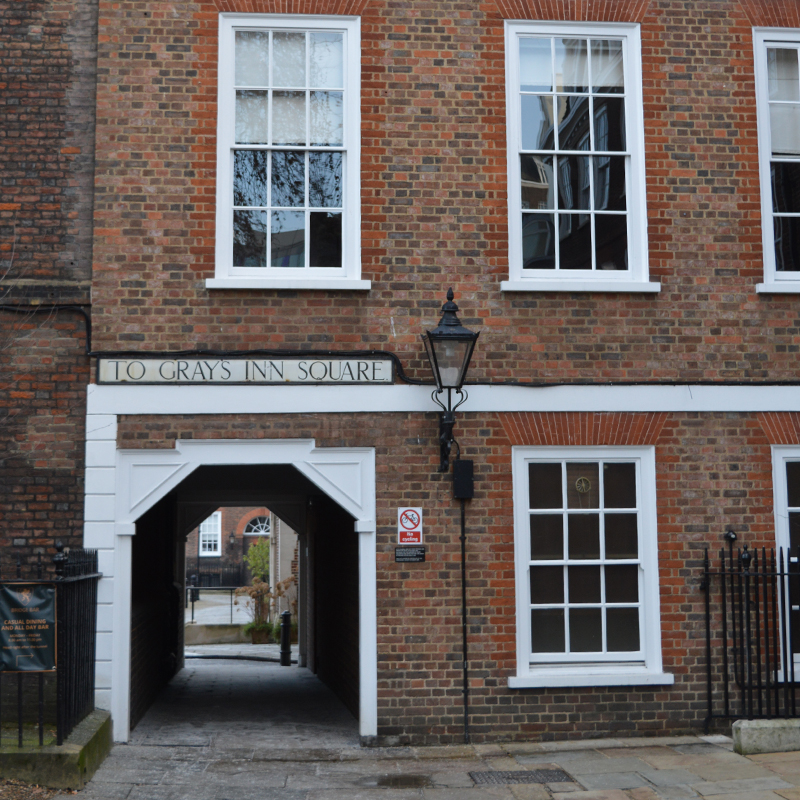
In Black Doves Season 2, the street outside 10 Downing Street has to feel instantly recognisable: a place where government power, public scrutiny and private danger meet. But the production did not film those exterior scenes at the real Prime Minister’s residence. Instead, it used Gray’s Inn in Holborn, with Jockey’s Fields appearing in the approach to Number 10. It is a clever location choice because the historic legal quarter can convincingly suggest the authority and enclosed atmosphere of Whitehall without reproducing the famous address literally.
Quick answer: Netflix’s Season 2 location guide confirms that exterior scenes for 10 Downing Street and Whitehall were filmed at Gray’s Inn in Holborn. Some interiors set inside Number 10 were filmed at Harefield Grove in Uxbridge. Time Out identifies Jockey’s Fields as the street used for the arrival shots. Netflix Tudum’s location guide and Time Out’s report provide the clearest published confirmation.

Why Gray’s Inn works as a stand-in for 10 Downing Street
Gray’s Inn is one of London’s historic Inns of Court, a legal institution whose buildings and courtyards carry centuries of professional and civic history. Its formal brick façades, enclosed squares and controlled entrances give the area a sense of establishment authority. For a political thriller, that visual language is useful: viewers read the setting as serious, traditional and connected to the machinery of the state.
The choice is also practical. The real Downing Street is a heavily protected working government address, not an ordinary film location. A production can recreate the visual grammar of the place elsewhere: a recognisable London street, imposing institutional architecture, controlled sightlines and carefully framed entrances. Gray’s Inn gives the camera a credible environment while allowing the production to manage movement, lighting and continuity.

Gray’s Inn and Jockey’s Fields: what was filmed where?
It helps to separate the exterior from the interior. Netflix Tudum says exterior shots for both 10 Downing Street and Whitehall were filmed at Gray’s Inn. Time Out adds that Jockey’s Fields, beside the Inn, was used for the street approach as Helen and Wallace arrive at Number 10. These details are complementary rather than contradictory: Gray’s Inn provides the broader location, while Jockey’s Fields identifies a specific street used in the sequence.
Some interiors that are meant to be inside Number 10 were filmed at Harefield Grove in Uxbridge. That distinction matters because a screen location guide can otherwise make it sound as though the whole residence was recreated at one address. The production used more than one place to build the fictional version of the Prime Minister’s home.

The production trick: building a believable political world
Film and television location work is rarely a one-to-one documentary record. A single fictional address may be assembled from several real places, with editing, set dressing, camera angles and sound design making the pieces feel continuous. The audience sees one coherent residence; the production team sees a set of usable spaces with different practical advantages.
For Black Doves, this approach also supports the story. Wallace Webb’s move into the Prime Minister’s office changes the scale of the danger surrounding Helen. Her private life is now connected to a public institution, and the show needs the setting to communicate that shift immediately. A familiar-looking government street tells viewers that the stakes have moved beyond private espionage into the heart of national power.
Gray’s Inn’s architecture helps sell the idea without requiring the production to film at the actual Downing Street. Its formal proportions and historic character make the location feel plausible, while the use of Jockey’s Fields adds a street-level approach that can be framed to suggest the familiar geography of Westminster.

Gray’s Inn is more than a film backdrop
The Inn is a working legal institution, not a purpose-built movie set. Its estate includes historic buildings, courtyards and the gardens known as the Walks. The official Gray’s Inn history describes buildings from several periods, arranged around squares and gardens; Historic England also records the historic significance of the estate and its landscaped spaces.
That real institutional character is part of what makes the location effective. The production is borrowing an environment with an existing identity. The result feels more grounded than a generic studio street because the architecture has accumulated real layers of London history.
Can fans visit the Black Doves filming location?
Gray’s Inn is a working legal estate, so visitors should respect signs, access restrictions and any private areas. The gardens known as the Walks have traditionally had limited weekday public opening hours, but access arrangements can change. Check the official Gray’s Inn website before making a trip rather than assuming every courtyard or building is open.
Jockey’s Fields is a street in the surrounding area, but that does not mean every view shown in the series can be recreated from a public spot. Productions may use temporary control, selected angles or nearby spaces that are not accessible to visitors.
What the location reveals about Season 2
The location choice is not just trivia. Season 2 places Helen closer to the centre of British political power, while her covert work makes that proximity more dangerous. The exterior of Number 10 is a visual shorthand for public authority; the use of Gray’s Inn gives the show a believable version of that world without turning the real government address into a film set.
It is also a reminder that Black Doves uses London as an active part of its storytelling. The city’s legal buildings, streets, clubs and institutional spaces help the series move between the public face of power and the private networks operating underneath it.
Frequently asked questions
Was Black Doves Season 2 filmed outside the real 10 Downing Street?
No. Netflix Tudum says the exterior scenes for 10 Downing Street and Whitehall were filmed at Gray’s Inn in Holborn, rather than at the real Downing Street.
Which street was used for the Number 10 arrival shots?
Time Out identifies Jockey’s Fields, beside Gray’s Inn, as the street used for the arrival shots of Helen and Wallace.
Where were the interiors of 10 Downing Street filmed?
Some interiors set inside Number 10 were filmed at Harefield Grove in Uxbridge, according to Netflix Tudum.
Is Gray’s Inn a real place?
Yes. Gray’s Inn is one of London’s historic Inns of Court and remains a working legal institution.
Can the public visit Gray’s Inn?
Some parts of the estate and its gardens may have limited public access. Check the official Gray’s Inn website for current visitor information before travelling.
Sources and further reading
- Netflix Tudum – Black Doves Season 2 locations guide
- Time Out – Black Doves Season 2 filming locations
- Condé Nast Traveller – Where Black Doves was filmed
- The Honourable Society of Gray’s Inn – The Historic Estate
- Historic England – Gray’s Inn historic register entry
By Shivam Das


